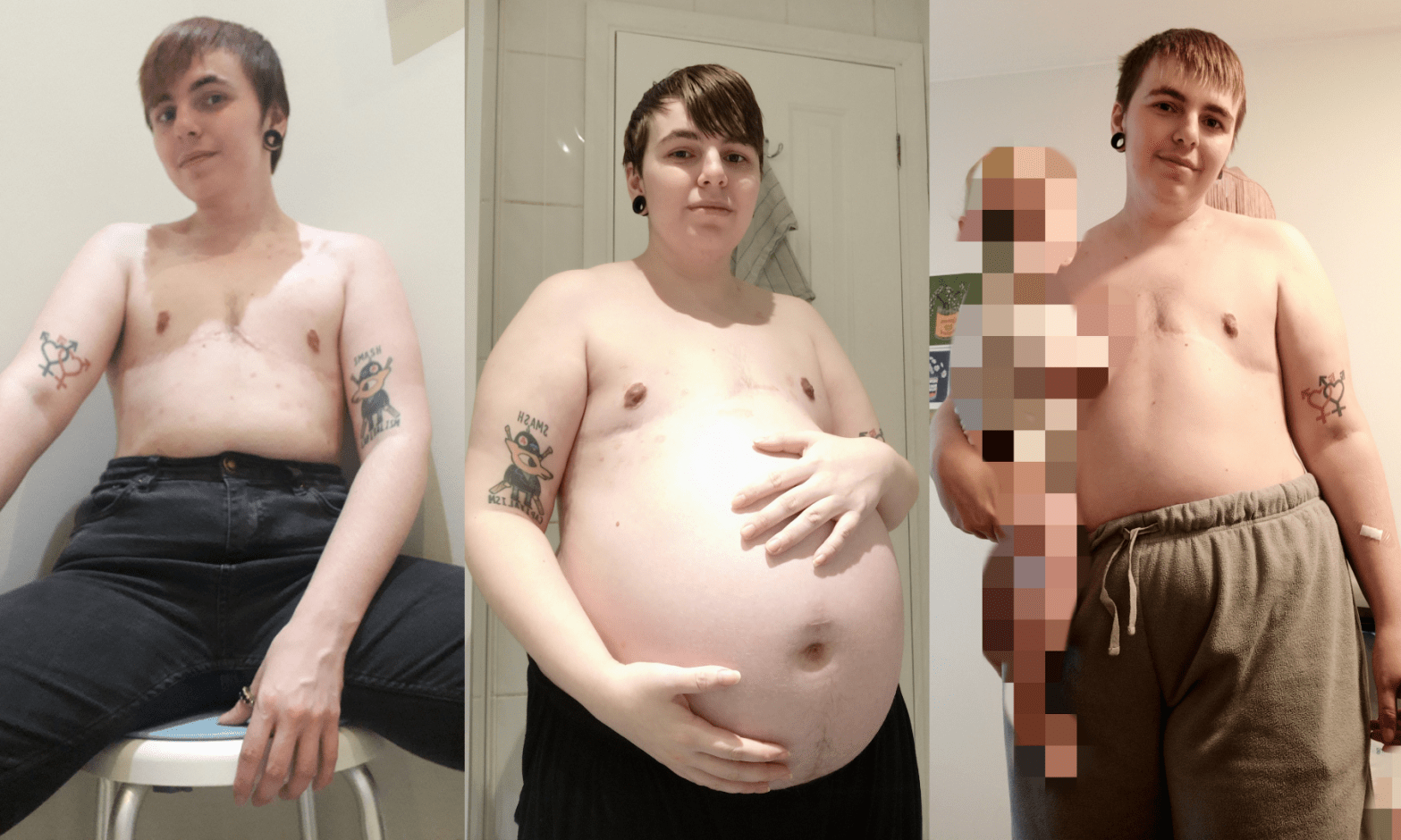
An account of one trans man’s pregnancy and childbirth.
This account will include graphic descriptions of traumatic events, medical abuse, and bodily functions where relevant. There will also be discussion of transphobia and other forms of bigotry I was subjected to while pregnant and shortly after birth. References will be made to my work (including sex work), personal life events, and medical issues that are unrelated to me being trans, however I will not be delving deeply into them here. Personal details about my daughter will also be omitted.
My purpose in writing this down is to have a record for myself and for other people to be able to read about one trans man’s experience of pregnancy, however I want to note that what I went through during pregnancy is by no means the default. I encourage people to seek out a variety of stories from people of different backgrounds before making a decision on carrying and birthing children. I have heard from other people with far better experiences and those who have had worse. Mine was a very traumatic pregnancy and birth. I personally struggled to find many full and detailed accounts at all, and many I did find were from trans men who didn’t deal with much dysphoria from pregnancy, so I thought contributing publicly was worthwhile.
Background:
I first seriously considered having a baby at 20 years old, shortly after realising I was trans but before I had pursued any kind of social or medical transition. Before this, children were already a part of my long-term goals, but I had a strong mental disconnect from the idea of motherhood that prevented me from thinking it through further. As soon as I accepted that I wanted to be a parent and distinctly not a mother, it felt imperative that I have a baby as soon as possible.
I was selling sex from a flat in Hertfordshire and for the first time in my life found myself able to earn enough to put some money into savings. My intention was to save enough for IVF, get pregnant and breastfeed my baby, and begin transition after weaning them early. Only a few months into working myself ragged by selling as much sex as my body was capable of letting me, it became apparent that money for IUI/IVF would take me a couple of years to get together. Then it could take a year or more to get pregnant. Nine months of pregnancy. A year of breastfeeding after birth. In a scenario where everything went as well as I could expect, I would be putting off transition by almost 5 years.
Two clients secretly removed the condom during sex while I was considering my options. Both times, I took a pregnancy test the day before my next period was due and it was negative. I didn’t want my future child to be incapable of contacting their sperm donor in the future, nor did I want them to have the knowledge that they were a product of sexual assault. When I got over being disappointed and relieved in equal measure, I knew I couldn’t continue as things were.
Transition became my top priority. Seeing the gender dysphoria I hadn’t understood in my teens as the core of why I felt like a disembodied thing piloting a husk, the grief that I had not transitioned sooner became overwhelming. I spent a few nights frantically searching for stories from trans men who had gotten pregnant after using HRT, then made the decision to order testosterone online while I waited to see an endocrinologist for a real prescription. With my transition underway, I hoped the time spent saving for IUI/IVF would be easier.
My sex work income plummeted with transition and my focus was once again purely on earning enough to survive. Within a year, having kids had returned to a dream of my future rather than something I was actively working towards in the present. I started to drink excessively again, having mostly kicked the habit prior, and buried myself in work and escapist hobbies.
Preparing to try:
Shortly after I turned 25, my bank sent me an e-mail saying I may be eligible for a loan. Despite having pushed down my desire for kids, my reflexive reaction was to calculate whether I could borrow enough for IUI/IVF. That thought quickly became an obsession and I applied for a £12,000 loans which was rejected within a week of my application. I spiralled into a depression and began drinking more heavily than ever. A month into this spiral my substance use had become very unhealthy and my alcohol consumption had put me into credit card debt. I found myself in pain any time I saw a baby or child, constantly thinking about my desire for kids, and often thinking about death. (I want to note here that children are not a cure for suicidality and should never have these burdens placed on them. This depression was a result of a combination of factors, many of them related to reproductive autonomy and dysphoria but also due to long-term poverty.)
One night I had a Discord call with a friend and I poured my heart out about my drinking. I had not realised that the excessive alcohol consumption was because of my unfulfilled desire to be a parent, but once she pointed out that they seemed to be related it all fit together. I broke down on call about how I had no idea what to do, the fact I would never have the money for IUI/IVF and felt the opportunity slipping past me, and she asked why I was so attached to that method. Suddenly I realised they were the same reasons I had initially balked at the idea of DIY HRT before accepting that it was superior for my circumstances; I felt it was more socially acceptable to have the sign-off of doctors and an authority to legitimise my choice. That night I decided not to take my next T-shot and to go looking for a donor.
Menstrual periods usually take a few months to return after ceasing testosterone, so I stopped all medications that might interfere with pregnancy and immediately quit drinking and smoking. I’d had immense trouble quitting both before, but had very little trouble with pregnancy as a goal. I also began taking pre-natal vitamins and went in search of a donor who wanted no parental rights, did not have disturbing intentions for donating sperm, and was willing to provide enough information for my future child’s benefit when they had questions or medical issues.
As soon as I accepted this plan, the source of my depression evaporated and I was functional again. I focused on selling enough sex to pay off my credit card, began saving, and looked hard for a job that would give me a stable income I could use for referencing and achieve paid parental leave from.
The trying phase:
Before the first attempt, I bought ovulation tests and began tracking my periods and ovulation and temperature to find the ideal insemination window. The stress I felt about doing everything perfectly was high, but getting pregnant without a partner is naturally more anxiety-inducing and I didn’t think much of it. Ovulation cannot be perfectly predicted, so co-ordinating the time and day of home insemination wasn’t easy. I spent a lot of time on forums, both for trans people seeking to get pregnant and for cis women intentionally becoming single mothers, reading through them for advice.
Dysphoria ramped up quickly once my period started, by which point I was often crying from the mood swings even though I was otherwise happier, and I scrutinised every possible change that estrogen was causing to my body. I decided to start trying as soon as my first period came, which was after my first positive ovulation test, so that I could minimise my time off of testosterone.
It was a few minutes after the first insemination attempt (using a plastic cup for the donor to ejaculate into and a smooth tipped syringe) that a particular trans-related obsessive thought first reared its head. I remember thinking with absolute certainty that I would not be able to get pregnant because my body was not meant to do it. The thought process was irrational and I still couldn’t shake it. I felt like my body knew it was supposed to be male, that this was against its nature, and that trying to get pregnant would only cause me pointless dysphoria until I broke from it and killed myself. Every negative pregnancy test compounded this feeling, and new fears joined my initial unfounded beliefs. I had unwelcome thoughts that each failed pregnancy test was some sort of cosmic punishment for being trans, that my dysphoria was making my body too stressed to be fertile, that even if I did get pregnant I would be guaranteed to miscarry… the list goes on. I still don’t quite know if this is because my internal body map doesn’t include a uterus, or whether it’s more about finding the idea of pregnancy horrifying enough for me to be in denial that it is possible. It could be something else entirely.
After 6 months of trying, I had a chemical pregnancy. This is a very early pregnancy loss, called a chemical pregnancy because it would never have been viable and is lost so early that the fertilised egg doesn’t start developing after it implants and is soon expelled. I only got a positive test because I was taking them on the morning my period was due every time. I was initially in disbelief, excited, and within a week had bled with a slightly delayed period. Soon the tests turned negative again. Having this happen felt like it confirmed my belief that there was something about me that was incompatible with pregnancy. At the same time, it proved that pregnancy was at least possible for me even if it didn’t stick. I broke my many months of sobriety to get extremely drunk and skipped trying for the next month to recover.
By 1 year from the date I had stopped testosterone, I was still not pregnant. This was after 8 attempts which I’d made sure were in the ovulation window according to my tracking. Through that time I had gained weight that distributed in a feminine pattern because of the estrogen. I went from having been stealth in more than one workplace to being misgendered almost 100% of the time. My face feminised, my facial hair became more sparse than it already was, and my voice felt like it regained more of the upper range that made it harder to keep it low. It was the most dysphoric I have ever been and worse for having been self-inflicted in pursuit of a goal that I was convinced was futile and yet couldn’t stop trying for.
For New Years 2025, I went to a party. Based on the timing of it, I had just started my period and thus knew I wasn’t pregnant again that month. I got drunk for the first time since the loss, smoked 4 cigarettes for the first time in a year, and started to seriously consider giving up trying and going back on T. I know much of this feeling was the dysphoria as well as the struggle to get pregnant, and the effect estrogen has on my brain in general, but I want to be transparent about what I believed in the moment: I sincerely thought that if I gave up on having a baby, I would kill myself.
I’m not sure how to explain these feelings to people who do not feel this need to have children. For me, it wasn’t a biological drive. I would gladly have raised a child that I did not give birth to if that was possible, and would even have preferred it. In my case, pregnancy was the only pathway I could realistically see towards fatherhood any time soon and so that made it my focus. Poor trans hookers aren’t generally permitted to adopt.
The plan became that I would keep trying for a few more months and then re-evaluate, with no real hope that anything would have changed by then. Two weeks after that New Years party I did another home insemination with a donor, convinced that my drinking would have lowered my chances further, and in February I had a positive pregnancy test after 24 hours of unexplained constant crying.
My friend had to deal with me knocking on their bedroom door to look at the test I pissed on. I had them confirm I hadn’t imagined the incredibly faint second line. I told a couple of people and otherwise decided I would keep the matter quiet until I was 12 weeks pregnant.
Early pregnancy:
By 4 weeks pregnant, I was intensely nauseated. The weeks in pregnancy are counted from the date of your last period, therefore at 4 weeks pregnant a person typically only conceived 2 weeks prior and has been growing an implanted embryo for a matter of days. Evidently I was very sensitive to hCG or other pregnancy-related hormonal changes. I began vomiting often and it quickly reached a point where I remember saying that every molecule of my body felt like it was individually nauseated. I’ve never felt so sick in such a prolonged way in my life. Every moment felt like the second before you vomit, except I would only actually throw up a couple of times per day if I rested as much as possible.
I forced myself to host a trans social meet-up I was hired to facilitate at 5 weeks pregnant, not yet accepting how suddenly disabled I had become by morning sickness. I vomited on the street the moment I got out of the train station, vomited into a bin again during the walk, then arrived and had to leave during the meeting twice more to vomit while the secondary facilitator took over for me. For most of the meeting I was useless and sipping on pregnancy-safe tea. This was a wake-up call, especially because it had made me so sick that I felt obligated to tell the other host about my pregnancy to reassure them that I wasn’t contagious.
Feeling so intensely sick continued and I wasn’t due for my first appointment until 9 weeks pregnant. The waiting game whilst being so sick was difficult, but the nausea made me feel distinctly pregnant in a way I’m not sure I would have felt without it. Every day I pulled up a tracker which told me my odds of miscarriage for the point I had reached in pregnancy, based on a number of life factors, knowing that it could not possibly account for everything relevant to my chances. I watched the chance of miscarriage drop and clung to that as my sole focus.
6 and a half weeks into my pregnancy, I started bleeding. It was spotting at first, then a short burst of bright red blood, then back to spotting. I went into the emergency clinic the next morning after making a call and getting the recommendation to. Until I got to hear the heartbeat, I was sure something would be wrong, and started immediately crying once they told me nothing was wrong and it seemed like I’d had bleeding from placental attachment which likely wouldn’t repeat. The staff around me for this internal ultrasound had no cause to refer to me in the third person, so I wasn’t misgendered by what I assume was pure chance, and the procedure was about as minimally traumatic as I can imagine it being for me while so stressed.
I told myself that if I worried about miscarriage more, the stress would cause it to happen. This thought caused me more stress. I kept trying to force myself in to work and symptoms built. I had a permanent gross metallic taste in my mouth and would randomly smell rotting other unpleasant smells which weren’t really there, all making the nausea worse. Some days I only dragged myself out of bed to use the bathroom, try and force down bland food or liquid calories, then would fall asleep from fatigue as my only escape from how sick I felt. The only things I left the house for became midwife and doctor’s appointments.
I distinctly remember telling my best friend, “I’ll kill myself if I lose this pregnancy, and I would also kill myself if I had to live in this state permanently without T and dealing with these pregnancy side-effects.” All my mental energy was spent on reminding myself that this would be a temporary state and I would have a child at the end of it. Suffering like this was only worth it because of the family I could build as a result. Looking in mirrors made me dissociate.
My inability to regularly work or even get out of bed led me to fundraising as my only means of covering bills. I didn’t expect to get so ill that I couldn’t push through it, even with as much reading as I had done on the possibilities, but it was intense. The relentless sickness didn’t ease up until around 14 weeks, and by 16 weeks I was back to being functional and had an early baby bump. Money I raised had just about covered my rent and bills for the period of my illness and I quickly went back to selling sex in addition to non sex work.
Pregnancy appointments and misgendering:
My notes state my gender on them, my name is legally Jack and that’s the only name on the system for me, and I filled out every form with “Mr” and included a note about my transness whether there was space for a comment or not. All of the documentation I was given had only “Miss” “Mrs” and titles like “Dr” as options, so I had to cross them all out and write mine in manually. I made it as easy as possible for everyone to know how to refer to me.
Almost every appointment I had at the antenatal clinic or hospital was with a different midwife or nurse or doctor each time, all but three never gendering me correctly. They saw these forms and notes and either forgot, chose to ignore them, or misgendered me pointedly with full understanding that I am trans. This happened if they needed to make a call in front of me to check on my results with another doctor, if they asked another member of staff to bring them something for me, or if more than one medical professional was in the room discussing my care.
On top of the specific misgendering came another sort that I was braced for, which was their tendency to constantly generalise all pregnant people as women and talk about how every woman is different or ask about the “other women” in my family, all implicitly grouping me in with women as a whole. I know it’s how they’re used to speaking, that I am a rare minority within their profession and that many of these workers have never had a trans patient, and yet I still think it’s ridiculous for anyone to assume it was purely accidental for them to speak about me this way. There were no corrections, no awareness in their speech, and they would speak about pregnancy this way even directly after we’d discussed the date I stopped testosterone and how I would not be breast-feeding because I’ve had top surgery. Seconds between talking about my transition and them saying “women do X when we…” after I asked a question about my own body as a man.
One appointment stuck out to me particularly, over the others where I was repeatedly misgendered, because the optimistic ignorance of my well-meaning midwife made me want to laugh out loud. She did the right thing at the beginning of our appointment and checked what language I prefer for my body parts, the pronouns I use and my relationship to the baby (father), but when I remarked that I was appreciative of it because others had not done the same she acted shocked. She told me it’s clear on my file that I’m trans and she would expect better from her colleagues. I was asked “really?” more than once when I stated the basic fact that I hadn’t been gendered correctly at a single one of my last dozen appointments.
I didn’t correct these instances of misgendering as they happened in the majority of cases. Sometimes I would find an excuse to mention myself in the third person and say “he”, a couple of times I corrected directly, and I typically objected when someone called me my future baby’s “mother” because it made my skin crawl so badly. The main reason for this choice was that I already detected a lot of hostility from medical professional I was meeting with, it was apparent to me that they didn’t care about gendering me right in the first place or objected to an expectation of doing so, and I didn’t want to get worse medical care for myself and (especially) my baby because I would be seen as a difficult patient. This massively impacted my level of trust of midwives and nurses. I never felt as though they had my best interests at heart and instead viewed them as gatekeepers for testing and ultrasounds who had to be appeased, and whom I had to tolerate touching me and speaking about me in uncomfortable ways.
Having someone with me would have lessened the difficulty in many ways, and I’m sure the misgendering was compounded because I was single and had no partner to model correct pronoun usage. Dysphoria kept me from bringing a friend, mostly because it made me feel ill to think of them seeing me that way and hearing about my reproductive anatomy. I didn’t think I could dissociate through the misgendering as well with someone else there keeping me grounded. I found it very hard to weigh the dysphoria and way it might damage my friendships if seeing my pregnancy care made them view me more femininely against the potential for more respect from midwives at appointments.
Conversations at some appointments also resulted in me having to explain obvious facts related to my transness because midwives seemed to be going off of a mental script. They would ask about past surgery, I told them I had a double mastectomy, and then they would ask me what support I would like with breastfeeding only a couple of questions later. This continued to happen even when I specified that the top surgery would make it impossible for me to produce enough milk for a baby and that I would not be able to breastfeed.
What my baby’s assigned sex would likely be was told to me during my 20-week scan. I told everyone who asked me that I didn’t know. Polite social scripts include the question of what gender a fetus is among the normal small talk to show interest in someone’s pregnancy, but I’d personally rather people asked nothing at all than that. I knew that telling people what she’d be assigned would lead them to buying different gifts, imagining her future differently, and frankly I wanted to protect her from the forces of misogyny as much as I could for as long as I could.
Late pregnancy:
The end of the nausea led to me being ravenous and gaining weight fast, much of which went to my hips and stomach and made me feel more intensely dysphoric. Stressful life events also happened in rapid succession. I lost my job outside of sex work. I was woken at 4am at a workplace occupation by over a dozen people taking the place apart, threatened by my landlord’s partner who entered my home despite being refused and insisted he would come back to drag us out, and together these incidents made it very hard for me to get enough sleep. I had nightmares most nights and couldn’t sleep more than a few hours at a time.
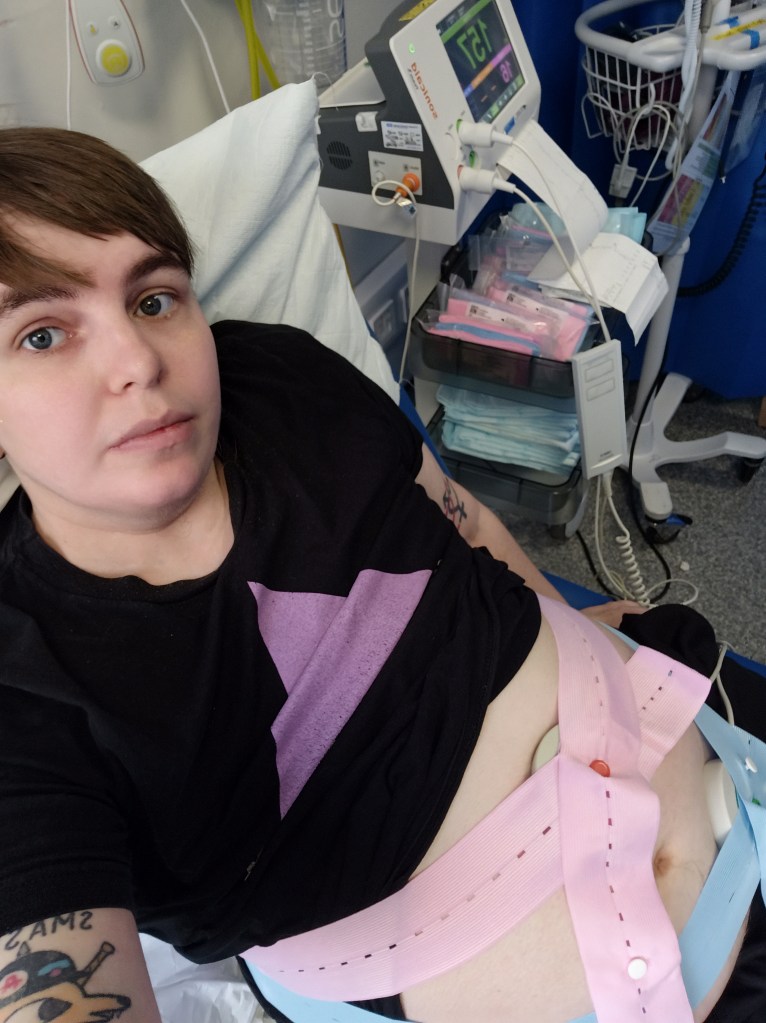
High ketones in my urine, persistently fast heart rate, and other symptoms had me being monitored in Labour and Delivery more than once in the third trimester. Other health issues unrelated to stress had me in excruciating pelvic pain that left me somewhere between barely able to walk and completely incapable on most days. I kept selling sex occasionally until my body couldn’t handle it anymore as the pelvic pain disabled me, at which point I gave in to try and fundraise again.
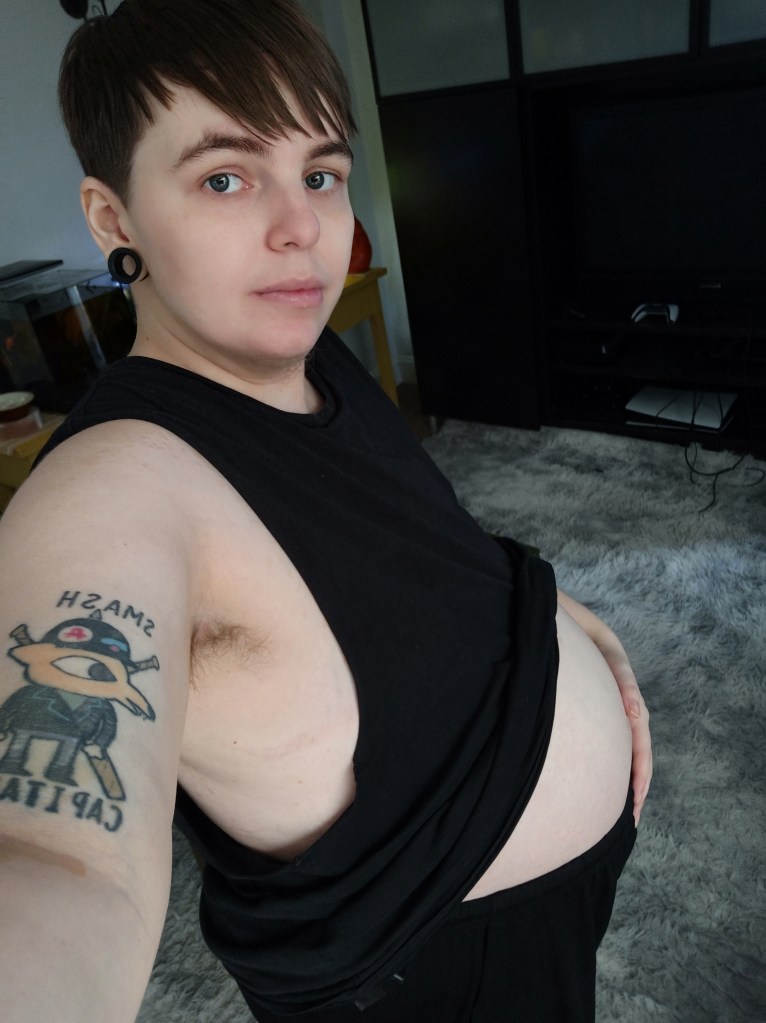
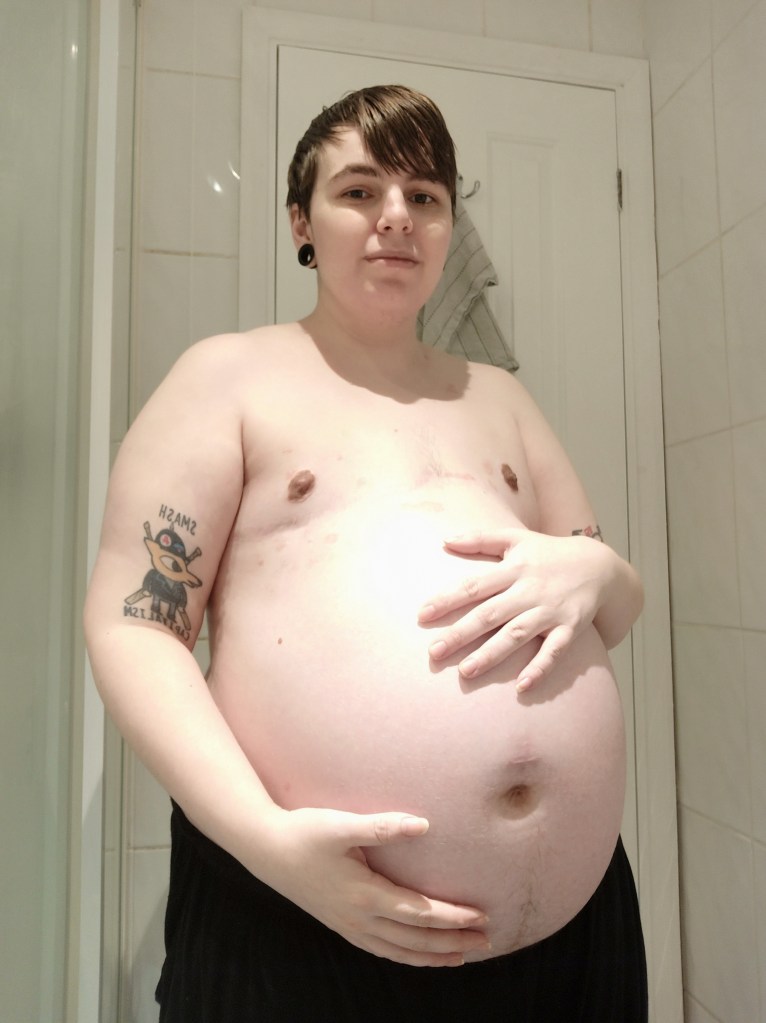
I’d started feeling sure that certain sensations were my baby’s kicks around 20 weeks, and I grew more attached to her every day as I got used to her patterns. This was the point at which I found the first positive thing about being pregnant for myself. It didn’t make me dysphoric to communicate with my kid by pressing on my belly and being kicked back or eating sugar and knowing she’d react soon after, even though that connection was enabled by my pregnancy. Focusing on this was a large part of how I coped with the most dysphoric moments. I think my mental health would have fared substantially better if my face had remained masculine off of T and if I could go back I would’ve prioritised growing beard hair (like with minoxidil) pre-pregnancy so that I would’ve had facial hair as a comfort.
Any time I went out in public, which was not often at this stage, I was viewed by practically everyone I encountered as a pregnant woman. An Uber driver criticised me for drinking a carbonated beverage and asked me what my hypothetical husband would think of me drinking that while carrying his baby. A couple of acquaintances who had never misgendered me before, suddenly did.
Staying inside was very important for my mental health at this stage. I wanted to be perceived by as few people as possible and forced myself to take pictures so that I could make decisions about sharing later if I wanted to. I’m not bothered by pre-transition pictures when I know I pass, and I was sure that I would want to be able to make comparisons later. They’re also useful for other trans people considering pregnancy, to differentiate between my dysphoria mindset and the ways my body physically changed.
I was intensely depressed in a way I had not been once since transitioning. Knowing the cause helped me to not lose myself to despair. It’s hard to fully remember the mindset now and do it justice; I think I have a tendency not to remember the intensity of the sadness once it passes. I do know I was nearly non-stop obsessively fearing the idea that something would go wrong and my baby would die and being certain I would kill myself after. I don’t want to understate how badly this harmed my mental state.
Birth:
By 40 weeks, I wanted to be done being pregnant as soon as possible, stop having doctors poking and prodding at me, and finally spend time getting to know my baby. They scheduled a date for my induction before 42 weeks, to lower certain risks that come from late deliveries, and it couldn’t come soon enough. I was exhausted.
In the days before I attended the hospital for my induction, I workshopped how I would respond to various instances of misgendering while in labour. Usually this is the bottom of my priority list when seeking healthcare, but I knew that being tense and angry whilst in so much pain would lengthen my labour and be worse for my baby. It couldn’t be left as a matter of dealing with my feelings about the mistreatment after the fact if it impacted my ability to safely give birth. I decided in advance how I would inform my doctor and correct misgendering, what efforts I would make to explain myself and when I would ask for a different member of staff if they were giving me worse care due to transphobia.
My induction date arrived and I hadn’t gone into labour, so I attended the hospital for them to push things along. The first doctor I met with explained that he’d highlighted my pronouns and desire to be referred to as “father” on my notes, and that they would be in bold red text at the top of all notes that my care team would see. He assured me that midwives and doctors would be briefed prior to interacting with me. It was the first time anyone had been proactive about supporting me as a trans patient for my entire pregnancy. The moment he left the room, the midwife or nurse I was left with told me that she would exclusively call me by my name and not any pronouns, so my expectations were immediately managed again.
The midwives and anaesthetist I saw after this mostly gendered me with he/him and corrected themselves the few times they made errors. It made a bigger difference than I thought it would to how tense I was. My water was broken, I was given an epidural which began to work, and with an IV drip I finally started to have contractions which were moving towards strong enough for me to push.
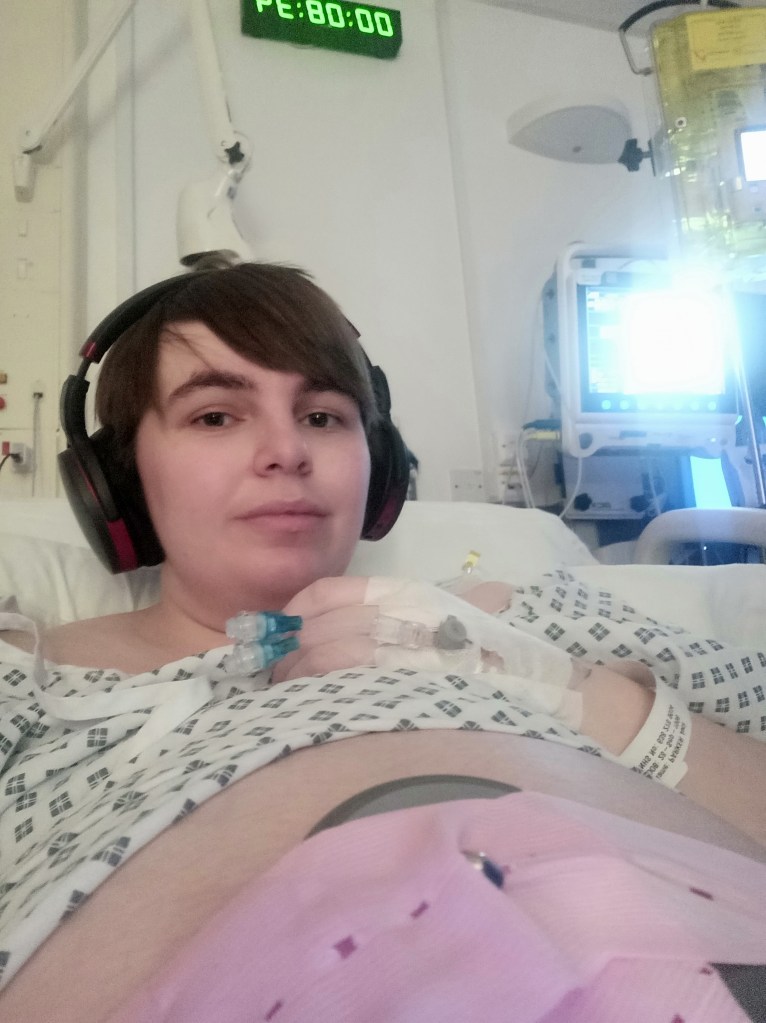
When the epidural dispensed each new dose, I could taste and smell something like hand sanitizer, so the anaesthetist shifted it in my back to stop that effect because it can suggest that some of the medication is getting directly into the bloodstream. After it was moved, it became less effective and they had me move onto my side and around to try and fix the issue of it impacting one side of my body more than the other. As labour progressed, it became less effective against the pain, but since I have a high pain tolerance and no reference for how painful labour should be, it took me a long time to realise the epidural was no longer doing anything to mitigate it. I pushed for a couple of hours before the pain surpassed what I could tolerate and remain lucid for, at which point the doctor decided that I needed an instrumental birth because my daughter wasn’t going to come out through pushing alone.
They prepared to transfer me to theatre and found that the epidural had come out entirely when the doctor took a look at my back. Moving to theatre was fast and hurried, I signed some papers giving consent for a spinal block and several other things, and then I got the good drugs that made me unable to feel my body from my chest down. The low blood pressure dip made me feel like I was dying for a moment until it was brought back up, but it was a great trade-off for the sudden absence of pain. I didn’t get to enjoy it much because of the total out-of-body experience it threw me into and my worry about getting my baby out safely.
I watched my legs be moved for me, unable to feel them and with even my arms being sluggish to respond. Contractions continued but I couldn’t feel them, so the doctor began instructing me when I should push and when to stop. Pushing was entirely a mental exercise because I couldn’t actually feel any of my muscles. I had to imagine hard that I was clenching or pushing and trust that my body was doing it, despite zero feedback in terms of sensation. A couple of pushes and the doctor was able to get the forceps in, and after a couple of pulls they sought my consent for an episiotomy. That means cutting downward from the bottom of the vulva and through part of the vaginal canal to widen the exit. I agreed.
My birth plan included the intent to refuse any offer of an episiotomy if I didn’t need an instrumental birth, because they actually tend to heal worse than natural tears and guarantee they’ll be at least a certain size rather than minimising damage. Had I known more about the need for additional space with instrumental births and how my own experience would go, I would’ve been induced sooner and not bothered with an epidural and tried to push for longer. Having reached the point of being in theatre already, those weren’t possibilities anymore and I agreed to an episiotomy.
The motion the doctor was making between my legs to pull my baby out after the cut seemed so forceful and extreme that I couldn’t believe it was happening to my body. I felt like there had to be massive damage being done. I know I was dissociating hard because I remember thinking that the visuals were horrifying and yet knowing I wouldn’t be able to perfectly recall it later because I was not able to process it in the moment. I already had PTSD from prior life events and now when traumatic things happen, I know almost immediately if the image is going to stick and haunt me or whether it’ll be fractured and blurred in my mind. This memory got fractured.
A little more pushing and a couple of pulls, then my daughter’s head came out fully and the doctor informed me that I had torn further. I couldn’t feel it. While my baby was being pulled from me, I thought about that cliché that the world tilts on its axis the moment you see your child for the first time and they become the most important thing in your life. Anxiety started to build in me that I wouldn’t feel it, that I would have been through all of this struggle and suffering and yet wouldn’t be able to connect to her, and so I couldn’t focus on information about the severity of the tearing.
My daughter was born and there was no air in the room until she cried. I don’t remember which doctor or midwife put her on my chest. I couldn’t tell you whether I was being stitched up at the same time or bleeding heavily or passing the placenta when she was given to me. It was exactly the way I was told it would be; the world narrowed to just her. Her face was bruised and her hands were purple and she was the most gorgeous baby I’d ever seen. I immediately knew it was worth it. I also felt the incredible weight of my responsibility to her.
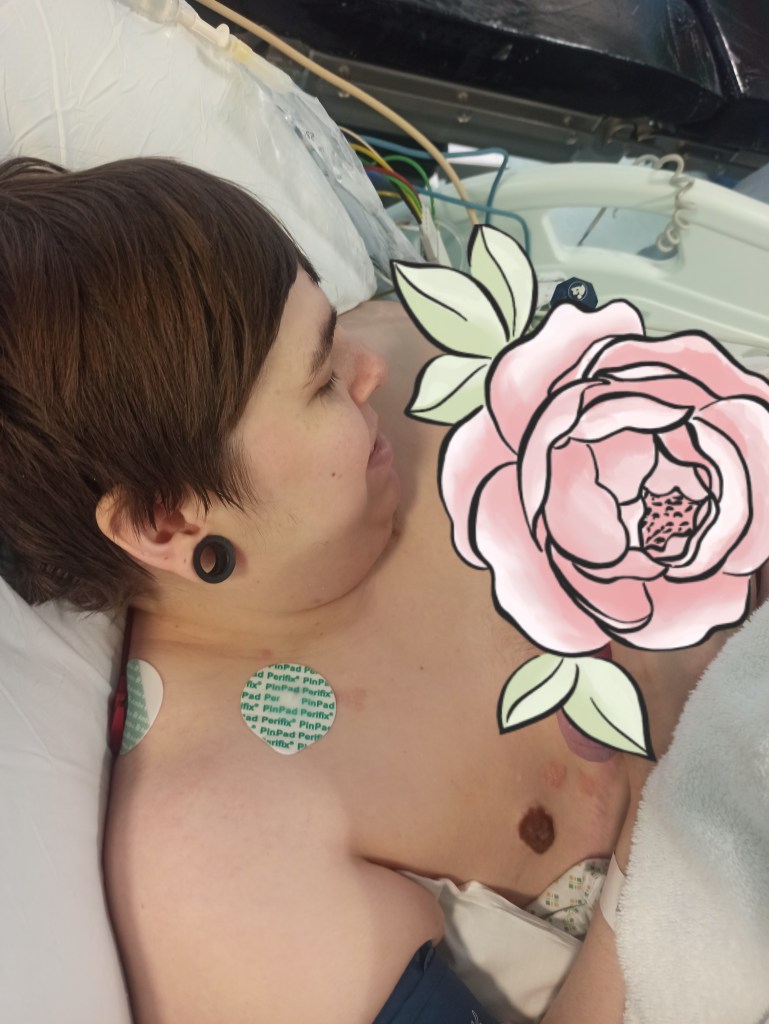
She was briefly taken to be weighed and get her vitamin K shot. I watched her the entire time and floated through a conversation about how I’d suffered a worse tear than anticipated which had connected between my vagina and anus from the end of the episiotomy. A third degree tear. They gave my baby back to me and I soothed her while avoiding thinking about my own body at all. Stitches were placed quickly.
Post-birth hospital stay:
After I delivered my daughter and was moved to my own room with her, I still had a catheter in and a bag clipped to the side of my bed to collect urine. I also had a cannula in my hand. A friend came to visit me and my baby and helped me to arrange some things in my room conveniently for me, like arranging my phone charger so that I could keep my phone charged and access it as needed. They also took away clothes that ended up covered in amniotic fluid from labour. At this stage, the feeling in my legs hadn’t yet returned from my spinal block and I couldn’t get up for myself.
Spending my first night in the hospital was frustrating because of how immobilised I was and the fact I could not even lift my baby in and out of her clear plastic crib without help. Every time I wanted to feed her, I needed to press the call button and request that they bring hot water to warm her milk and to collect the formula I’d brought with me that was stored in a fridge outside of my room. I had no control over how slowly or quickly staff might come and couldn’t predict ahead of time when my newborn would wake wanting to be fed. When my baby needed her nappy changed, I had to ask a nurse or midwife to throw the tied off nappy bags in the bin for me afterwards. Being alone in a hospital with strangers periodically wanting to look at my genitals while I was sleep deprived and exhausted and had a massive wound inside of me from giving birth was already extremely difficult to tolerate, but the immobilisation turned it into a waking night terror.
The midwives assigned to me during the night were supportive and kind. Understaffing made it so that I was still seen more often by unknown nurses than by the two of them after we were introduced, and as more and more people had to pick up my baby and put her in my arms I kept thinking about infection risk to her and how uncomfortable it was to have so many people see me in such a vulnerable state. I didn’t sleep at all, because my baby needed feeding every couple of hours and during the brief respites in between there would be midwife check-ins or someone taking the bins out from my room or other interruptions.
Less than 24 hours after I delivered my baby, I was given a new midwife who we’ll call Vicki Rushton because that is her actual name. I also recently discovered that she sells 1-on-1 antenatal classes and shares information about pregnancy and childbirth on Instagram.
Vicki introduced herself and informed me that she had worked with trans patients before whilst in Australia, surrounding fertility and pregnancy. Her implication was that this should set me at ease. Naturally, she immediately had to be corrected on misgendering me during our first interactions. This included speaking directly to my baby and referring to me as her “mum” despite me making it repeatedly clear that I’m her father, referring to myself as her dad, and telling her that this was very important. She had to be corrected by me each time and did not improve, nor did she correct herself without me saying something each time. She misgendered me more often than she got it right.
I asked to get the cannula out of my hand which had been placed during labour, because it was painful and bothering me and no longer needed. When Vicki removed it, she used a cotton ball to hold pressure afterwards on the wound. She then got curious about how it looked and took the pressure off only seconds after removing the cannula. I have no medical training, but even I would not be so foolish and negligent as to remove pressure from a wound that I had just pulled a cannula out of. My blood sprayed out of it hard and got all over my arm. She put the cotton ball back on it and had me hold it in place. Vicki washed her own hands and I expected her to come and help me or provide me with wipes. Instead, she started to collect her things without offering support. At this point I could feel my legs again post-spinal, yet with the catheter still in and attached to the bed it was very hard for me to get up. She knew this. I had to ask her for wipes before she rushed out without giving me pain medication.
In hindsight, this is obviously the moment I should have asked for a new midwife. She had shown herself to be transphobic and incompetent. There were a lot of reasons I didn’t. I didn’t know whether other midwives would be just as bad, particularly given my experience with them while pregnant. I assumed the cannula removal incompetence was an isolated incident stemming from lack of experience taking them out, because Vicki told me her decades of midwifery experience didn’t typically include supporting people on the ward post-partum. Everyone working on the ward who came to see me seemed busy, took time getting to me or forgot things they said they’d get, so her forgetfulness about my pain medication seemed like systemically poor care rather than a personal failing. I didn’t expect to see her much more that day and hoped to be home by the next morning. I wasn’t in a position to advocate for myself with the state I was in.
When the catheter was taken out soon after, I was immediately so relieved because it would finally allow me to stand up and get moving and pick up my baby without needing to call for help. I was most excited on a personal level to be able to shower. The reality of getting out of bed whilst stitched together from my vagina to my rectum was more difficult. There was still a lot of blood, sitting up on my stitches and preparing to stand was excruciating, and walking was a slow process. Back pain wasn’t on my radar until I stood up, everything else having taken precedence over it, but it was a fight between that and the pain of my stitches every time I took a step. I made it to the bathroom while my baby slept, hoping for a shower, and discovered that the showerhead attachment was broken and on the floor. A midwife later told me that the shower in my suite had been broken for many months.
Removal of a catheter starts a TWOC protocol, but this was not explained to me when mine was removed. I had no understanding that I might not be able to urinate still, or that I would be checked for my ability to void or what would happen if I could not. From my perspective, the removal of it was the last step before I could finally go home. When I was unable to urinate after I was taken out, I used the call button and told Vicki this. I was instructed to drink more water. That didn’t work. Over time, it became painful because I felt like I badly needed to pee while there was a blockage stopping me. I told Vicki and she kept insisting I should drink more and telling me to keep trying. She told me it “would be bad” if I could not make it happen and that I “would not want to have to have the catheter back in”, as if it was my fault that my bladder was still paralysed since the epidural and spinal block. She spoke about my inability to urinate as if I wasn’t trying hard enough, meanwhile I was sobbing on the toilet trying to relax or clench in different ways to make it happen.
While all of this was going on, I was still changing my baby and feeding her. From a few spit-ups and some memorable poop nappy leakages, she’d gone through all four outfits I’d brought with me to the hospital that fit her. She was born too big for the other two. According to the NHS list of things to bring with me, this was overkill. With her swaddled and out of other clothes, I’d had to request a friend bring me more from home who was due to arrive early that afternoon. Vicki commented that my baby was swaddled in a nappy and a hat rather than wearing a onesie, and I told her that my friend would be bringing more clothes to tide me over until I was discharged. Obviously I hadn’t packed with the expectation I’d need a spinal block and a catheter, so I’d been expecting to leave a handful of hours after birth. Vicki showed up with a large bag of clothes that she’d never asked whether I wanted shortly after, which I accepted gratefully even though I didn’t need them, and I changed her into a onesie while waiting for my friend to bring a stack of more outfits.
At around midday, I stopped drinking more water because I could still not urinate and became fearful that my bladder would burst because of how much I’d drank. Vicki still suggested I drink more and keep trying, but finally assured me that she would be back soon put a new catheter in. Turns out that I had a mental health referral scheduled for 1pm, which I was not told the timing of in advance, and when the mental health assessor arrived she did so with Vicki. Vicki said I would get my new catheter put in after the assessment, even though I noted my desperation to urinate. This meant that for the entire time my mental health was being assessed, I badly needed to urinate and was already frustrated, by no means the ideal state to be in whilst having my mental health judged.
Foolishly, I was sleep-deprived and in enough pain that I answered the questions I was being asked with no consideration for how bigoted hospital staff might try to use these disclosures against me. I was honest about having sold sex, about my mental health history including a psychiatric unit admission at 16, all with the assumption that they would already know these things from my medical file and that it would be a bad idea to refuse to answer. I didn’t want to be seen as difficult or hiding things when I knew there was no reason for anyone to be concerned about my ability to care for my baby. She was planned for, I’d purchased everything she needed, and I was ready to be at home with her and recover.
After this assessment, Vicki showed up to put my catheter in. I already felt that Vicki was incompetent after how poorly she handled removing my cannula, but she’d delayed my care enough that I was worried about damage to my bladder if I asked for another midwife. I figured I could get through her putting the new catheter in, which she told me she’d done many more times than removing a cannula. I ultimately agreed for her to do it because I was in too much pain to wait any longer.
When placing the new catheter, I had to remind Vicki more than once that my 3rd degree tear was painful. She had failed to bring me my painkillers when they were due so it was already hurting a lot more than it should have, and she wiped over and touched my stitches without numbing in a way that hurt badly. I told her she was hurting me and made pained noises, but she changed nothing about her approach. The midwife who inserted my catheter during labour, after an epidural and with no genital tearing at the time, used numbing gel even though the epidural itself had already dulled the sensations. Vicki didn’t suggest any while I was unmedicated with a severe tear.
As Vicki was putting in the catheter and hurting me, she repeatedly called me “good girl”. This would have been unacceptably condescending and inappropriate even if I were not trans. Given that I am trans and I had corrected her repeatedly about misgendering before this, it was especially unacceptable. I froze. It felt equally as violating as times I have been raped. It was humiliating that she was speaking to me with the same tone and manner and gendering that she was using towards my infant daughter. If she noticed my total shutdown, she didn’t acknowledge it.
Once the catheter was placed, it began rapidly draining my bladder. The bag was huge with a very long tube and not suitable for getting around with easily. I was distressed and thinking about how the lack of mobility had impacted my ability to pick up and put down my daughter made me even more emotional. I desperately wanted to think about anything besides the violation I’d just felt and the way the catheter was reattached made me feel even more vulnerable. It still hurt as my bladder was draining.
When I got my voice back, I commented that I was unsure how I could get around, especially because putting underwear and shorts on over the catheter bag seemed impossible due to its size. Instead of explaining to me that the tube could be disconnected and reconnected once it drained, Vicki started to detach it as she mentioned it was possible to do so. Vicki was not wearing gloves anymore, said “urine is sterile”, and then pulled apart the tube. It wasn’t until the moment she’d already separated the halves that I worked out that’s what she’d been intending to do, because it was so unfathomable to me. Vicki not only stopped my distended bladder from draining while I was still in pain, but also covered my leg in urine from the detached tube. Some of the urine also got on my underwear as she pulled it up with the tube hooked through, making her detaching it useless because obviously I was not going to continue wearing soiled underwear. Vicki went and washed her own hands but offered me nothing to clean myself up with, again. I had to ask her for wipes and then she started dabbing at me herself with them until I flinched away and told her to stop and that I could do it myself. I didn’t give her permission to continue touching me and was surprised that she had. She misgendered me again during this.
From the moment she pressed on the tear to my rectum until she left the room, I felt like everything happening around me was a scene in a film rather than my life, a type of dissociated viewing of a traumatic event that I was already used to happening to me. I kept my composure long enough to get Vicki out of my room to get other supplies I needed and as soon as she left I pressed the buzzer for a nurse and began immediately sobbing uncontrollably. I asked the nurse who entered to hand my baby to me and requested to see the ward manager as soon as possible. I was explicit that Vicki should not to be let back in my room.
An entire litre of urine drained over the next 30 minutes or so, making it obvious that my bladder had been dangerously overfilled. This was documented casually in my notes by Vicki with a simple “1000mls drained” and no acknowledgement of the seriousness of this.
When I asked for the ward manager to complain about Vicki’s treatment of me and to request a new midwife, two women arrived shortly after and entered the room. They identified themselves, one of them in a high up position at the hospital, and I believed my complaint was being taken seriously and a second member of staff was essentially chaperoning the conversation. Neither disclosed that they were also there for the purpose of following up on the safeguarding conversation.
Instead of taking my complaint and coming back to talk about my mental health when I had recovered and gotten support from my friend who was in the waiting room, they decided to interrogate me about my mental health history and transness. It started with small background questions which I assumed they were asking for context as part of me reporting Vicki. We discussed the general mistreatment I had experienced during pregnancy and the issue of transphobia in my care, which they were sympathetic about. I explained that I am not the sort of person who complains about every instance of misgendering and that I am used to being mistreated because I am trans, to impress upon them that Vicki’s behaviour went far beyond what any reasonable person could be expected to put up with. One of the women talked about how she sees Black patients deal with issues like this when deciding whether to call out racism, a struggle she stated she’d experienced for herself. I see now that she brought up her experiences with bigotry as an attempt to relate to me and convince me to open up more.
I was reporting being abused by a member of staff and that is clearly not a reasonable time to question me about my mental health, particularly because absolutely anyone would be upset after being abused and having urine poured on them only minutes before. The conversation rapidly shifted in that direction anyway. I was asked about my home life and they admitted having concerns after my conversation with the assessor. Both women asked me if I needed any support and I told them no; I already have robust support and made this clear. I live with 3 close friends who had all committed to supporting me in various ways. They discussed my previous psychiatric unit admission and sex work, expressing that they were concerned about how I would cope and that this sort of intervention was typical for any parent with a serious mental health history because of the risk of post-partum psychosis or depression.
I was quickly told that they wanted to refer me to Children’s Social Services. This horrified me. I had no need of CSS and did not want even more people prodding around my home and interfering while I was still recovering from a traumatic birth and adjusting to having a newborn. I told them I didn’t want that. They told me if I didn’t agree then they would inform the Health Visitor and report their concerns regardless and it would look bad if I hadn’t complied for myself. I took this as a threat because it clearly was one.
In addition to this, it was bizarrely suggested that I should access housing support and seek housing for myself and my baby. I already had stable housing living with friends who I am close with, and who were ready to support me in caring for my baby. The suggestion to isolate myself struck me as deeply discriminatory against single parents, because I am certain such a thing would never be suggested to someone living in a house with their partner. The fact the people helping me with childcare were friends rather than a romantic partner is irrelevant, and this was a huge overstep. It was especially weird that it was brought up multiple times after I already said I was happy with my living situation.
I was told that one of the two members of staff would come by the next day to show me what they wrote in their referral so I could see it before they sent it off. No-one came to show me this referral or to speak to me about it again. I was clearly profiled because of being transgender and not part of a heterosexual nuclear family unit, leading to this discriminatory report to children’s social services. That became undeniable when I later got to see the report for myself.
Later that night I requested that my next midwife change my catheter because it wasn’t draining properly. I’ll also admit that I had the less rational reason of not wanting equipment that Vicki had touched to remain inside me, like I continuation of the violation from earlier. The new midwife was kind and understanding and changed it for me without complaint, careful and willing to use appropriate numbing for the change. She did not press on my fresh stitches at any point and instead poured sterile solution over the area. If I hadn’t built up a tolerance to people seeing a part of my body I’m very dysphoric about through sex work and learning to dissociate, I’m not sure how I’d have continued functioning with so many people seeing and touching my genitals. Even this instance where everything went well was so stressful.
The next morning, yet another new midwife was assigned who told me that I could not get the catheter out that morning. When I questioned why, she said after a failed TWOC that they needed to wait a while to retry and that changing my catheter during the night had essentially reset the clock on that. I broke down because it felt like I was being trapped to be further abused at the discretion of whichever midwife might be assigned to me next. My discharge was being delayed because of this and I hadn’t gotten a minute of sleep in multiple days. I was also desperate to be able to shower and walk around again, knowing my recovery was being made substantially worse by how long I’d been in bed post-birth. The compromise was that the midwife found me a smaller bag to attach to the catheter which could easily be strapped to my leg. I have no idea why this wasn’t provided in the first place.
With the new more portable bag for my urine attached to me, I managed to put on loose shorts and finally clean my space and sort through my baby’s clothes. I was able to stretch again and pick up my baby without needing to call for someone. I could change her while standing up instead of laying her on the bed between my legs. While changing her on the bed as I stood over her, I leaned forward slightly and found that my body almost gave out. Steep learning curve. I felt like there was a tether to my baby that didn’t let me more than a few steps from her, but the added freedom made me feel able to breathe again.
Eventually my catheter was removed and we started the TWOC process again. The first time, I urinated and then activated the call bell as I was told. A midwife arrived after a while and it was then that I found out I had not passed, but that after voiding my bladder I was going to be manually checked with insertion and removal of a catheter to make sure I wasn’t retaining urine. Having this sprung on me after the experience with Vicki meant I immediately felt sick and shaky. I wish this had been explained to me at this point and it had been made clear that, while there were risks if it turned out I was retaining urine, that I did not have to agree to this procedure. In the state I was in, I chose the path of least resistance and agreed. Another insertion without numbing gel, and because the midwife had taken so long to arrive and I’d consumed so much water to make myself pee again, a decent amount of additional urine came out. This meant I had to try again.
For the second attempt, I refused to urinate until after the midwife arrived. I told her that I wouldn’t because I was sure I’d voided totally and that there was only urine when she checked because she’d taken so long to arrive that my bladder refilled. Her assurances that she’d get to me fast when I called weren’t enough because I was told that a second failure would mean they’d re-catheterize me for a week. There was again no mention that I could refuse this, and if I’d been in my right mind then I’d have been nowhere near so afraid because I would have known I could say no.
Finally the next time came, I drank less and went to the bathroom and was checked within minutes afterwards. Nothing retained. Cleared. I cried again when the midwife left, for a long time. Luckily my baby slept through it all because newborns are very protective of their rest early on. Loud noises were no match for her ability to sleep and I was envious.
Since the catheter was the last barrier to me going home, I was told I’d be discharged that evening. My baby already passed all her own checks. I arranged for a friend to bring the necessary supplies for me to leave, car seat included, and prepared. No-one discharged me and then in the evening I was given a new midwife, whom I asked about this and who told me she had not been told I was ready for discharge yet but I’d get my papers in the morning and be able to go. I managed a couple of hours of sleep that night, interrupted by my baby waking up for a feed, and another 20 minutes in the early hours of the morning.
The next midwife I was assigned who came by in the early morning said she’d heard nothing of my discharge either. She said I wasn’t fit to be let go because of my catheter, while I was standing in front of her clearly without one in. After I drew her attention to that, she said it wasn’t updated on my notes, then speculated that I hadn’t been allowed to leave yet because of a report that was pending. She said perhaps I was being held because of the safeguarding team needing to meet me again. When I seemed confused, she said, “I probably shouldn’t speak more on this” and I realised she must be referencing the CSS referral. I confirmed that I knew about it, and said that them making a referral has nothing to do with my fitness to leave with my child. Having later read through the notes, I can see it was explicitly stated that my discharge should not have been delayed due to the CSS report in them, making this interaction even more perplexing.
I sought support from friends and sex workers in my community, calling and typing messages to many to get help. Naively, I thought that my mistreatment and being trapped at the hospital was stemming from the fact I’d disclosed a history of sex work rather than my transness, because it seemed more plausible that they’d believe sex workers are inherently unfit parents than the same bigotry about trans people. It was very hard to bolster myself and prepare for verbal confrontation when I had a baby I needed to protect and keep calm, had to seem extra stable because my fitness was already being called into question, and was experiencing the crash of hormones after birth that is horrific even for people in the best of circumstances.
A couple of hours later, the last midwife I would see took over from the previous and I explained all of this to her. I insisted I would be going home that day and no longer tolerating the mistreatment I had been experiencing. Being kept in the hospital over a day longer than necessary, not accounting for the fact that Vicki’s mistreatment undoubtedly caused me to be catheterised for longer and kept me there for extra time, was extremely bad for me. I was constantly awoken by people coming in, stuck in a place I’d been treated abusively and therefore being repeatedly triggered, had no privacy, and my baby was in a much more disruptive environment than she would be at home. I needed to sleep. I wanted peace and quiet at home. The midwife spent time listening to me, affirmed that what had happened to me already was unacceptable, and got me out that day by hassling the doctor for me to be discharged.
First days home:
For a brief window after our mid-afternoon return from the hospital with my baby, I mustered enough energy to change and feed her and eat an actual meal. Then she fell asleep and I placed her into her crib for the first time. One side of the crib had an unzippable mesh window which opened onto my bed, so I was able to lay down next to her without a barrier and put my hand right next to hers. We both slept for 5 hours, after I had only managed a few hours total over the previous 5 days. I woke up to my baby crying for a bottle and grabbed a single-use bottle of liquid formula while I shook with sobs over how relieved I was to have gotten some rest.
More of my sanity was clawed back with each 30 minute to an hour of sleep during her naps, in between feedings and nappy changes (for her and myself) and constantly burping or rocking her. It was during one of those naps when I was hoping to get a little more sleep for myself that I got the expected call from social services.
Fortunately the woman from social services was reasonable and supportive. She told me outright that she couldn’t make sense of why the report had been made from the information on it, that she’d called the hospital for more details about the report because she assumed something had been left out, and asked me a few basic questions before agreeing that the only explanation she could find for the report was bigotry. I’m not sure if she realised how nice it was to hear someone from within the system call it out, but it mattered to me a lot. I was encouraged to do a subject access request to see the report myself, told it contained irrelevant information about my transness and housemates as if they were a reason for concern, and finally had some reassurance that not everyone would assume I’m an unfit parent because I’m single and trans and low-income.
Towards the end of the call, the social worker told me that a bigoted social services report was bad enough, but that she was especially sorry it had happened to me immediately after birth when I’d barely begun my recovery. That element of frustration had more attention called to it when my baby woke up needing to be fed, the call having lost me the chance at another nap. We wrapped up the conversation and the case was closed without further investigation.
Once I did a SAR later, I got to see the children’s social services report. In the section to state “what are you worried about”, the fact I am trans was the first thing listed. It is disgusting and transphobic that this was treated as a concern for my baby. In addition, the fact I live with 3 friends was noted alongside those friends sexualities as if that was relevant information. Blatant homophobia. As well as mentioning my transness and personal details about my housemates relationships, it was specified in the same section about concerns that I had a double mastectomy. Why? Because I would not be breastfeeding, as many people don’t? There is no good reason this element of my medical history needed to be shared.
Alongside these bogus concerns, the report misgendered me multiple times and implied that I was lying about my relationship to my only other housemate by saying I “deny” being in a romantic relationship with them. I don’t even know where this came from, beyond my friend visiting me the evening after my daughter was born and providing support. The cherry on top, the referral also states I was tearful due to a traumatic delivery and characterizes my distress as purely based on that with no admission of post-partum mistreatment by staff.
With the children’s social services call handled and after a home visit from another midwife to check on me and baby, I finally got to start catching up on sleep and recovering. The trauma hit me hard and the first few weeks were brutal. The treatment after birth had reignited my dysphoria to its worst, I had night terrors about being tortured via catheter, and I would have gushes of blood and pass large clots that the helpline insisted were normal when I called. A week after birth I still hadn’t passed a bowel movement, though I’d been taking laxatives the entire time, and the constipated feeling became a constant pain. I didn’t seek medical help because I wanted every doctor and midwife and nurse to stay the fuck away from me after what happened.
It was 8 days post-birth that I sat on the toilet and finally started to pass a bowel movement. Instantly I felt an intense pain and pit in my stomach that told me I was going to die, a large gush of blood came out vaginally at the same time from the clenching, and my baby started screaming from her crib. I felt that sort of animalistic sharp pain that makes you want to curl up in a ball and die to escape it. Shitting felt like being torn open again, I was light-headed and pitched forward almost passing out from it, and then I passed everything that had been held back like I was having the worst enema of my life. I’ll never claim I’m shitting my guts out after food poisoning again because nothing compares to that.
I took about a minute to collect myself, carefully dragged myself to the shower and detached the shower head to thoroughly clean myself, and then went to tend to my daughter who was crying for about 5 minutes all together. I wasn’t trying to get through one day at a time, it was every minute at a time. A few seconds. She fell asleep soon after and I laid down to nap for the hour I’d probably manage, tears continuously pouring down my face that didn’t feel like actual crying, and I hoped I’d die in my sleep. I couldn’t imagine killing myself because of the guilt that came with the idea of abandoning my baby, but dying in my sleep would be guilt-free. If I were religious, I might have prayed to God for a haemorrhage. It wouldn’t be my fault and my friend would hear if my baby cried for too long and come and get her relatively fast. My baby was little enough she couldn’t even see me from her crib, let alone realise and understand my death, and I figured it was the least awful way for me to go.
Ideally, you’d get mental health support while feeling this way. I had a lot of suicidal ideation and would wake up before my baby cried to check her breathing constantly. I was obsessive about sterilising things, having flashbacks to birth and my treatment after, and I thought constantly about ways I could make sure my baby was safe before I killed myself for the first month. I was convinced I’d never be viewed as a man by anyone again and I’d permanently feminized (and ruined) myself. If not for the CSS report and additional scrutiny I was under, I would’ve sought help, but they left me too scared that I’d be deemed unfit and have my baby taken away if I showed any weakness.
Around 4 weeks post-partum, I started testosterone again. I’d heard that 6 weeks was the recommendation but was desperate to make my body my own again. The most extreme dark thoughts had also subsided somewhat. The testosterone had a huge effect on my mental state from there. I’d forgotten how much testosterone improved my mental health the first time I got on it, and how much estrogen damages me personally. A few weeks later it was like I was a new person, still in the newborn trenches but actually capable of smiling and getting excited over every new little movement my baby learned.
I am extremely fortunate to have a robust community of friends and comrades and a wider social circle who all showed their support. I didn’t tell most of them a fraction of how awful I felt, but having them express their excitement for me allowed me to get a little of the joy of new parenthood back. The first months were really rough and it’s not worth thinking what would’ve happened if I’d gone back to an empty house with no-one to call.
Now:
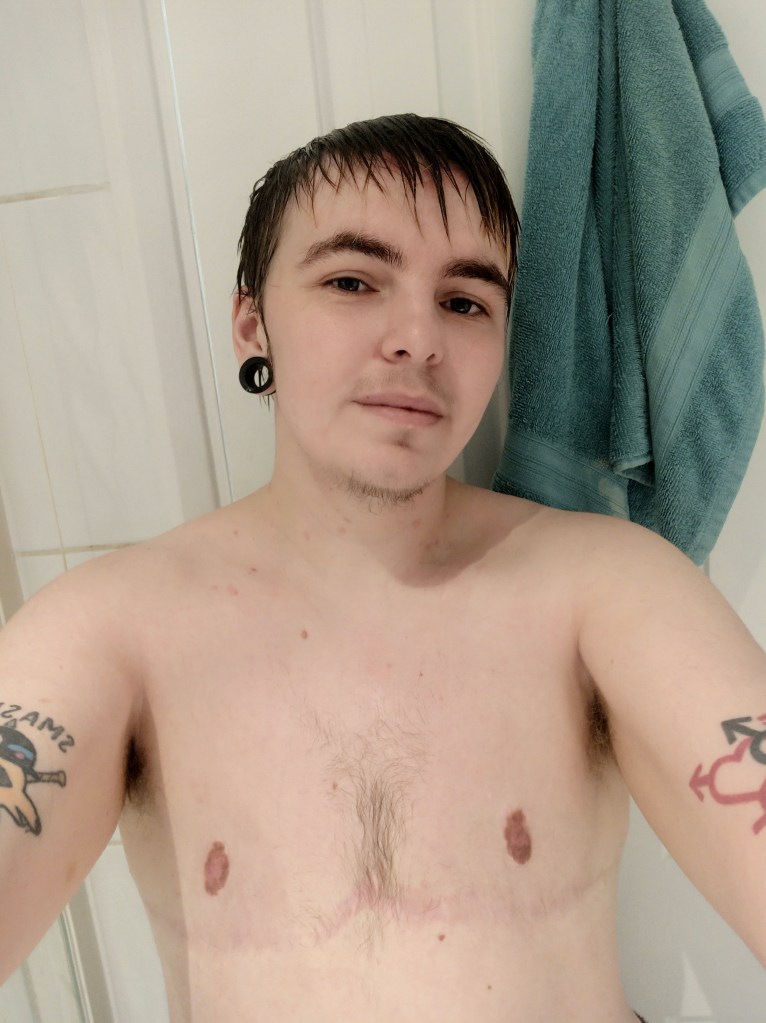
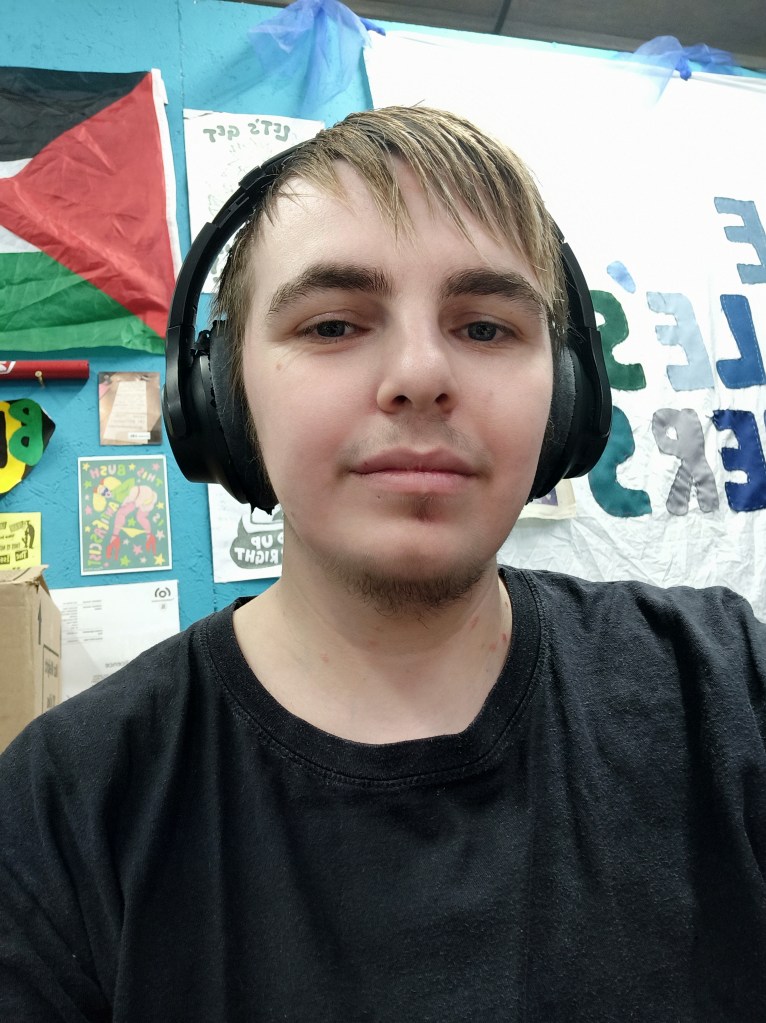
Testosterone quickly brought back my mental equilibrium. I took control of my transition and goals much more firmly this time around, to combat the sensation that I was set back so far. My T dose keeps me on the high end of the male range instead of my previous HRT regimen which had much more dramatic peaks and troughs and kept me around the low-middle for most of the month. I’ve been using minoxidil to grow more facial hair. I’m consciously working on my body composition. Less than a year post-birth I’m back to passing to new people I meet.

My third degree tear still causes me pain and discomfort during certain kinds of sex and I haven’t been back to the doctor to be checked or assessed.
After going through this, I don’t think I could handle another pregnancy, regardless of my desire to have more children and provide siblings. Had a lot of angst about that and came out the other side, after one night off from baby where I read Detransition, Baby and got stupidly drunk. I’m not going to pretend this isn’t still a sore spot, but I’m reaching acceptance about it. I don’t want to limit my choice in a future partner based on reproductive capability, or place pressure on anyone I might date or want to co-parent with to carry a baby, so it’s something I’m working on letting go.
Having my daughter was the best thing I’ve ever done. While there are a lot of things I’d change about how I handled pregnancy, the supports I (failed) to put in place beforehand, and the medical failures, it was so worth it. Juggling work and childcare and the guilt I feel when I’m not with her is going as smoothly as it can. Every day gets easier, she communicates more, and I’m reminded of why I did this.
She’s started saying “Dada”.

