
Whilst not all radical feminists have exactly the same positions on sex work, there are common beliefs and arguments. Focusing on the big picture is useful, but sometimes it can help to look at a single person with these beliefs as a way to unpick their reasoning on an individual level.

I often get into arguments with radical feminists on Tumblr, and I’d like to break down the comments made by one user in this post (which you can look at in full here).
These arguments come from a radical feminist who took issue with me discussing how people can better support sex workers’ rights.

This is a false description of what sex work is. Consent is not “sold” when a person sells sex. Their consent is conditional upon being paid, but that is not the same thing. In the same way that I’m not selling consent for a condom when I require a condom be used for me to agree to sex, I’m also not selling consent when I require money. What I am selling is sex itself, as a service, and I retain the right to say no and to have boundaries. When you pretend that selling sex is selling blanket consent, this lie encourages people not to see the difference between when we agree to sex with a client and when a client rapes us and encourages clients to believe that we are selling away our right to have boundaries.
I sell sex and I am not an object. The idea that I’m objectifying myself by selling sex and fighting for workers’ rights as I do so is laughable coming from someone who is themselves insisting that I am a product. I am a person using my body to provide a service, as are other people engaging in prostitution, and we are people while we sell sex in the same way that a hairdresser is still a person while they cut hair or a care worker is still a person while they wipe their client clean after using the toilet.
Sex workers selling sex does not encourage clients, or men in general, to view women as sex objects. The men who do so are misogynists who will do that regardless, and who treat sex workers the worst in part because the public (and even radical feminists) allow and encourage it by objectifying us too.
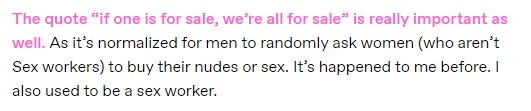
One person selling sex doesn’t imply that every person is available to purchase sex from, just like how one person being a firefighter doesn’t imply that anyone can be expected to go and fight fires. This is nonsense that is claimed about sex work because sex workers are so detested that people want to hold us accountable for the behaviour of abusive men who may or may not be our clients. Victims are not responsible for their abusers behaviour, and sex workers are not responsible for the actions of our abusive clients or of men who hate sex workers and are also violent misogynists.
Even if no-one agreed to sell sex, misogynistic men would still request to buy sex or nude photos from people who don’t want to, because they don’t care about consent in the first place.
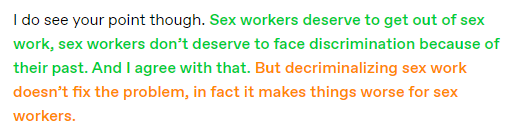
Sex workers deserve to be able to leave sex work if we want to, and we shouldn’t face discrimination. If you do not decriminalize it, it is impossible to avoid that discrimination – when elements of prostitution are illegal there necessarily has to be discrimination, it’s structural. If it’s a crime to buy sex, the earnings are proceeds of crime and banks are made to discriminate against sex workers. If it’s a crime to run a brothel, sex workers who work together for safety are criminalized and cannot pass background checks for future jobs or will face criminal penalties. If it’s a crime to make money from the proceeds of prostitution, it’s illegal for sex workers to hire security or even rent a home because the landlord or security are “profiting” from that prostitution!
Decriminalizing sex work makes sex workers safer because we’re able to access workers rights, to work together for safety, to have banking access to save money and be in less precarious situations, to hire security, to report mistreatment without risking arrest themselves, and so much more. When our clients aren’t criminalized, they’re more willing to provide screening info and we can assess clients more easily for our safety.
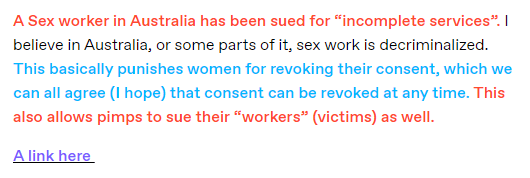
(Here’s the link that was provided, a sourceless blog post, and here’s a link to a well-sourced article by Scarlet Alliance which is a sex worker activist group in Australia.)
It’s not true that a sex worker has been sued for “incomplete services”. It was claimed in 2019 that sex workers “could be” sued for incomplete services, but this is a misrepresentation of the law:
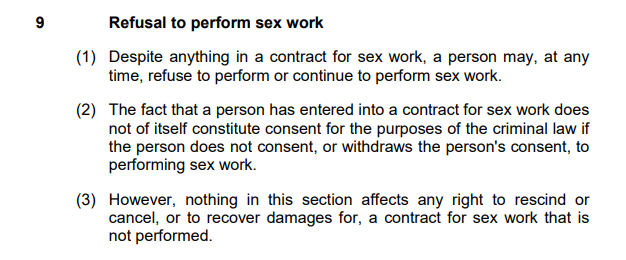
What the law does do is say that if a client pays for sex, and the sex worker doesn’t want to have sex and changes their mind, that the client has the right to their money back. If instead of this, you would like it to be illegal for the client to pay for sex at all, this far increases the likelihood that the client will assault the sex worker when they refuse, because the client has no recourse to get their money back and clients in this situation often become entitled and abusive.
The law does not, at any point, give managers of sex workers the right to sue the sex workers who work for them. I’ve actually read the law, and I assume most radical feminists havent, so it’s understandable why they’d make this error.
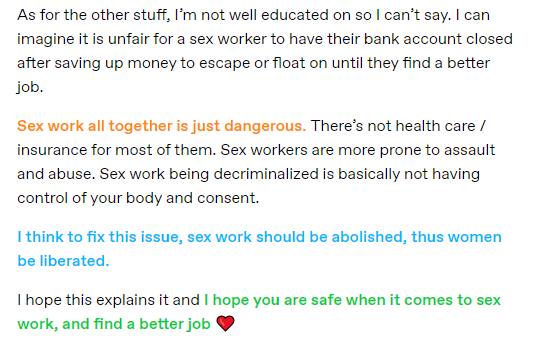
Interested for someone to imagine it’s unfair, rather than to be able to state it outright, when a sex worker has their bank account closed, and even then to caveat it by giving a scenario where the money is being used to escape sex work! Whether someone is saving to leave sex work, looking for another job or not, or is simply living off the money they earn from month to month, sex workers do not deserve to lose our bank accounts. Losing an account means we can’t rent most places, can’t use certain types of public transport, can’t use various shops or online services, can’t get a mortgage, can’t reference our credit history, can’t get a phone contract… I could go on.
Sex work is indeed often dangerous, particularly prostitution. It’s made that way by criminalization and stigma. Decriminalizing it gives sex workers more rights, more freedom, and more control over our bodies and consent.
We must abolish poverty, not prostitution, because trying to abolish prostitution is not possible and only means that the people who find themselves with no better options are left to engage in sex work with less rights and whilst in more danger. You need to get rid of the things that push people to sell sex when they don’t want to, like poverty, not put people in more danger once they’re already selling sex.
Radical feminists do not wish me well. They want the veneer of acting like they care about me whilst simultaneously advocating for laws like client criminalization (the Nordic Model) that will make me face worse mistreatment or get me killed. Fuck off.
 Jack Talks About Sex Work
Is it possible to completely abolish rape? Abolish violent crimes? Yet we make laws against them. Abolishing poverty will remove the reason many people, women and LGBT people specifically, enter “sex work”. Abolishing poverty would mean that even if the option of prostitution was completely removed for you, you still wouldn’t be left in poverty. The upside is that the women forced into it, have an exit. Even in places where prostitution is legal we’ve seen major upticks of disenfranchised women (immigrants to the area) be left without legal protections, be trafficked into it. We have many, many prejudices that go into the stigma of prostitution, and saying “okay it’s legal now, no more taking advantage of these women!” isn’t going to undo those stigmas. And even if every radical feminist in the world got into the idea that prostitution is okay, well it’s not the radfems raping and killing prostitutes even in legal countries. It’s males. Both the person you wrote this whole response to and myself are former “sex workers.” We just happen to very vehemently disagree with you on who the real danger is here.
LikeLike
We don’t disagree at all on who the danger is – clients and police are the people most likely to harm sex workers, both through rape and other forms of assault. What we do disagree on is how to lessen that danger. You seem to foolishly believe that making it illegal to pay for sex will stop people becoming sex workers and selling it, and you are demonstrably wrong. You also don’t seem to understand the difference between legalizing prostitution (something I do not advocate for) and fully decriminalizing it (what I do advocate for, which allows sex workers access to workers’ rights).
When you make it illegal to pay for sex, you leave sex workers with only clients who are already willing to engage in crime and who are incentivized to assault us to keep us quiet. You leave us unable to report assaults, because even if it’s not illegal for us to sell sex the work itself is illegal and our income will be seized and our lives will be torn apart with our method of earning money will be significantly cut off from us if the police find out. Sex workers are more likely to be murdered when you make it illegal to buy, because it forces us underground more and leaves us without rights or the ability to work together for safety.
Radical feminists aren’t usually the ones killing or physically abusing sex workers. Instead, you’re advocating for laws which make us more likely to be abused.
You can exit sex work much more easily when you’re not being criminalized, whether directly or through your clients. As someone who wants to support people to stop selling sex if they don’t want to be doing it, which has been the case for me many times when I have been selling sex, I know that the legal situation which makes it the easiest for us to stop is full decriminalization. I hope eventually you understand that too, and stop advocating for laws that increase the danger for your position as someone who is a “former” sex worker and therefore won’t be impacted by these laws the way someone like me who had sex for money today will be.
LikeLike
I believe anti-prostitution laws ENCOURAGE the very activities they seek to discourage. People (women and men) often enter this business because they are desperate for money. Giving that person a criminal record makes it HARDER to get “regular” employment. Thus, the record itself traps the person in desperation and poverty. Decriminalization will make it easier for people to leave when they wish.
LikeLike