
Any time I hear a sex educator or artist of pornographic drawings call themselves a sex worker, I cringe. On the occasions where I see them wield this label as if it makes them an authority on the topic of sex work, that second-hand embarrassment twists itself into outrage. My instinctive reaction is to say that these people are not sex workers and to berate them for claiming to be. When I started to vent about this issue to a friend, the definitions I gave of what a sex worker is had me wondering where the line really was, and I could see why these civs (non sex workers) had gotten confused.
The term sex worker was coined by Carol Leigh in an attempt to create terminology which did not degrade those who sell sex and could be used to unite anyone who performs paid sexual labour under one (red) umbrella. Since its inception, with the landscape of sexual labour ever-changing due to the internet and shifting cultural norms, people have argued over who should be counted as a part of the sex worker community. What has remained is that the label has its primary use in grouping us all together due to our shared political struggle.
A group of sex workers necessitates the existence of a type of job deemed to be sex work, so understanding what falls into this categorie is essential.
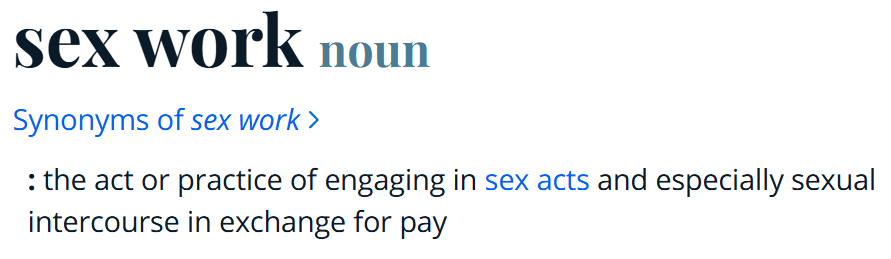
Merriam-Webster defines it as “the act or practice of engaging in sex acts and especially sexual intercourse in exchange for pay”. Wikipedia describes it as “the exchange of sexual services, performances, or products for material compensation.” Oxford calls it “paid employment in the sex industry, comprising prostitution and pornography.”
People who draw sexual art commissions, often explicitly for their client’s sexual satisfaction, aren’t engaging in a sex act. They are creating a sexual product for compensation. What they’re drawing is also form of pornography, so would it be wrong to say that they’re part of the sex industry because their job involves porn?
I would say that a sex worker is a person who sells sexual services or engages in sex acts for money. No inclusion of selling products or generally working in the sex industry, so as not to include brothel managers or dildo manufacturers. This still leaves a lot of room to argue over what counts as a sexual service or a sex act, but based on my own very loose way of understanding these things, I find that this work for me.
I see dirty talk to a person who is getting off on it to be a sex act, so phone sex operators count. Strippers are selling a sexual service by performing for sexual gratification, so they count. Drawing a pornographic image isn’t a sex act or a sexual service, it’s the creation and sale of a sexual product, so NSFW artists don’t count. Taking photographs of a sex worker for our adverts isn’t a sex act or sexual service, so photographers don’t count. Erotica writers aren’t selling a sex act or sexual service, they’re selling the sexual product of the book or short story itself, so they don’t count.
All of the people who fall into the category of sex worker for me are those who sell the fantasy of ourselves as the object of desire, not who create something entirely separate for people to project onto. Recording fake moans into a microphone might be sex work if it’s for a video on OnlyFans, or it might not be if it’s a voice for a character’s brief sex scene in a cartoon. There are some things, like selling used underwear, that become an extension of someone’s sex work but wouldn’t count in isolation.
What leads to my anger is not that NSFW artists and writers would get confused, but that the ones dabbling with this language are privileged enough not to have the term stick to them whilst still being able to appeal to their marginalized identity to promote their work. Multitudes of strippers use terms like exotic or erotic dancer to avoid being labelled as sex workers, those who sell sex in person may try to claim a level of respectability with the term escort, and yet we all get grouped together as hookers and whores regardless. We cannot escape being classified by insults that denote our status as sex workers.
If you include everyone who draws smut or writes erotica under the label of sex work, you make it a lot harder to do advocacy for those of us selling sexual services. I would have to change my language to talk about the danger we’re in, because smut artists and erotica authors simply are not in the same situation. If I have to start listing the exact people I’m talking about each time I can do so, but being able to say “sex work” and include hookers and strippers and porn actors and phone sex operators, without every other worker who does something tangentially related to sex, is useful to me.
None of this is to say that artists and writers cannot be targeted for the sexual content they create, particularly when it is of a taboo nature, but this plight is much more similar to that of queer content creators of all types who often have their work suppressed or criminalized. They’re persecuted as perverts, not as sex workers.
Perverts and sex workers have long been close allies, and I hope that we can continue that relationship without rendering the language we each use meaningless as the rise of different types of internet porn blurs the lines.

