
On December 13th, the UK Crown Prosecution Service released new guidance regarding “deception as to sex” for rape and sexual offence cases. To summarize this guidance in the simplest terms, it treats a trans or intersex person not disclosing their gender identity and/or the sex they were assigned at birth as a form of deception which negates consent. It treats a trans or intersex person having sex whilst keeping their trans or intersex identity to themselves as a form of rape.
Intersex people (trans and otherwise) are mentioned only briefly and yet they are still expected to divulge their assigned sex according to the same rules as trans people, with no clear rules or details covering their situations which will undoubtedly often be different from those of perisex trans people!
This interpretation of part of the existing Sexual Offences Act (2003) places an unreasonable burden on trans and intersex people to inform our sexual partners of our medical history, while no such burden is placed on cis perisex people who are allowed to rely on assumption. The guidance treats a person’s trans identity as something so fundamentally relevant to the act of sex as to nullify consent on the basis of the transphobic distress that may be caused upon discovery. This guidance suggests courts should considers us to be rapists if our sexual partners are sufficiently transphobic or bigoted against intersex people.
When I heard about this guidance, my thoughts immediately went to the sex workers I know who don’t disclose that they’re trans or intersex to clients and what might happen to them. Some are trans women who have had bottom surgery and can pass as cis women during sex, some are trans men who are not medically transitioning or are hiding any hormonal and surgical changes and claim to be cis women, some are intersex people who don’t want to explain the specifics of their sex to every client, and others are non-binary people in situations where they don’t share that they’re trans. I personally hid that I was trans from brothel clients even at the point when I was months on testosterone and with a passport that said I was male, because I needed the money and higher numbers of clients that came with them thinking I was a cis woman.
As is evident from one of the cases mentioned to set a precedent, McNally v R, sexual assault charges are expected to be used against trans people who engage in any kinds of sex acts without telling our sexual partners our assigned sex. We’re expected to proactively tell them because we should expect people to assume our cisness unless expressly stated otherwise, and lying to hide being trans is regarded similarly to breaches of bodily autonomy like secretly removing a condom.
There are a multitude of reasons that trans and intersex sex workers might keep their assigned sex to themselves:
- For a trans woman selling sex who has had bottom surgery, it may be possible for her to pass as a cis woman even when nude and receiving oral sex or vaginal penetration. Due to transphobic pressures from the client base, this possibility can become a necessity. Chaser clients who fetishize trans women typically expect them to have penises and many non-chaser clients don’t think of searching for trans women’s escorting ads or will avoid them based on transphobic assumptions or beliefs. Not to mention the transphobic harassment that comes with simply having an escorting ad up and being openly trans! These pressures ultimately push a lot of trans women who reach the point where they can pass to be closeted regarding their transness for safety.
- For an intersex person who is not visibly identifiable as intersex, they may choose not to disclose that they are intersex and instead present themselves as a cis person who whatever sex they are likely to be assumed to be (whether this is what they were assigned at birth or whether this is a result of surgery and/or hormones).
- For a trans man who has not had bottom surgery but who is able to pass at least some of the time as a cis man, he may choose not to disclose his transness to clients when performing acts which don’t involve his genitals. He might do this so as not to be reported and kicked out of transphobic gay cruising venues with a transactional sex culture, such as saunas or clubs.
- For a trans woman who has not had bottom surgery but who is able to pass as a cis woman at least some of the time in certain contexts, she may choose not to disclose her transness to clients when performing acts which don’t involve her genitals. This may be particularly likely in street-based or brothel-based environments where clients are unknown to her and could react violently if she reveals that she is trans. To minimize violent encounters, this might be her best option.
- For a trans man who has had bottom surgery, it may be possible for him to pass as a cis man even during sex acts involving his penis. This might be a choice made to avoid having to explain what a trans man is or what phalloplasty is to a client who has never heard of them.
Trans and intersex sex workers are already at significant risk if we are discovered not to be cis and/or perisex by a client. The reasons for not sharing this information aren’t about seeking power over someone or preying upon them, but are instead about protecting ourselves from harm in the event that the client is transphobic. These are clients who are attracted to us and want to interact with whatever body parts we’re using to provide the service they’re paying us for.
Though many of these issues exist for trans and intersex people who are not sex workers, the higher average number of partners that sex workers have and the higher frequency with which we have to hide being trans or intersex means that sex workers will be targeted most under this horrific new guidance.
Those writing this guidance appear not to have considered that some trans people might “live and identify” as one gender but present themselves as a cis person of their sex assigned at birth for the purposes of sex with strangers. The group who do this are most often sex workers, who are used to being overlooked, but unfortunately this leaves many of us in an unconsidered legal limbo. We have to try to guess at whether we might be considered rapists based on some unclear phrasing in a guidance document for the law.
The idea that I might be unjustly labelled a rapist if a particularly transphobic client I saw during a certain era of my brothel work found out I’m trans and went to the police is vile. It turns my stomach as someone who is a survivor of many rapes, one of which took place after I’d started medical transition but while I was still working under the guise of being a cis woman. When I had been on testosterone for a few months and had come out as trans to everyone except my clients, I lived in fear of various clients who scrutinized my genitals or my voice or the sparse facial hair stubble starting to push through. I was terrified of being brutalized by those who mistakenly thought I might be a trans woman who’d had bottom surgery or who asked more and more specific questions about the growth of my clit and got rough with me.
It is our bodies that clients are interacting with, not our true authentic selves, and that’s true whether it’s our transness we’re hiding or anything else about our lives. Sexual partners, paid or unpaid, are not entitled to know every facet of us.
The nightmare doesn’t end here.
Though the entire part of the Sexual Offences Act (2003) that we’ve covered is about “deception as to sex”, the section of the guidance covering conditions which may be considered relevant to whether the complainant is able to freely consent also suggests that gender identity might be a sufficient factor.
The phrasing used in part 1 of Evidential Considerations in the legal guidance is “prosecutors will need to ascertain whether the suspect’s sex and/or gender identity was a matter of importance”.
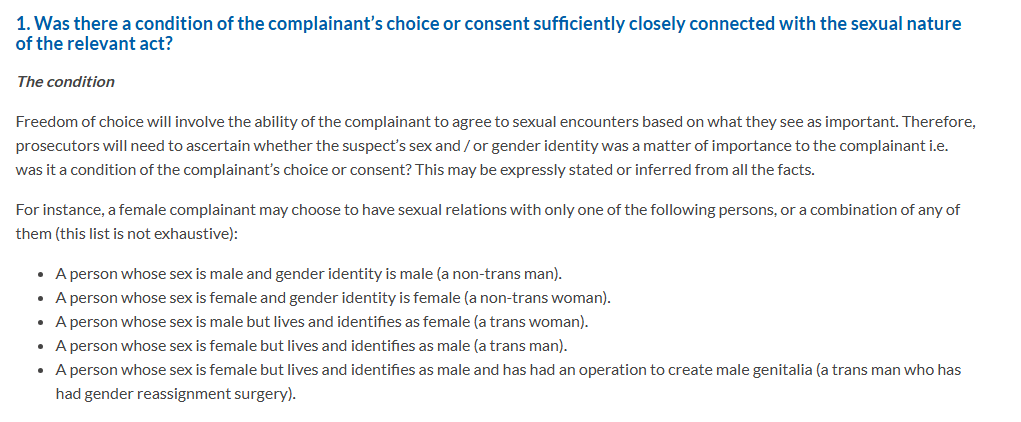
Then, in the list of types of people someone may restrict their interest to as a condition, various genders of cis and trans people are listed as well as trans people who have had specific surgeries. The text clarifies that a complainant may choose to have sexual relations with only one of the following types of person, in addition to the possibility that they might choose multiple.
Taken literally, a trans woman who claims to be a cis man or a trans man who claims to be a cis woman for a sexual encounter and doesn’t disclose that they are trans is also committing a crime, if their partner picks only a cis person of a specific assigned sex as someone they’d have sex with.
By the logic of this guidance, if you are out as trans full-time and generally live your life according to your gender identity, you can neither present as a cis member of your birth assigned sex or keep your trans status private whilst presenting as your actual gender when you have sex. In all circumstances you are forced to come out or risk being prosecuted for a sexual defence, no matter whether your sexual partner assumes or you lie to protect yourself.
Ultimately it is clear to me that this guidance isn’t meant to make sense or be reasonable, it’s meant to paint as many innocent trans and intersex people as possible as sexual predators and get us locked up with real offenders. This is happening at the same time as a national conversation about whether trans women should be allowed to be placed in women’s prisons, with calls for decisions to be made at the discretion of those with power in the legal system who are encouraged to consider the type of offence when placing someone. It is happening at the same time that politicians are pushing for the criminalization of sex workers’ clients, placing sex workers in yet more danger.
The first people to be targeted will be sex workers. The volume of sexual partners, higher frequency of the need to hide being trans or intersex, and public scandal associated with discussions about our work, all mean it could never be any other way.
More than any of the other awful news I’ve seen recently about legal changes impacting trans and intersex people, reading this guidance created a deep pit in my stomach. The trans and intersex sex workers around me have all my love and I will never let us be painted as predators for protecting ourselves and maintaining our privacy.
If you’d like to read about trans and intersex sex workers in general, sign up to be notified when the Transactional Intercourse pre-order campaign launches on Kickstarter! It’s an anthology which will include 30 trans and/or intersex sex workers’ essays and personal narratives.

 Jack Talks About Sex Work
The Crown Prosecution Service are breaking human rights laws here. Trans people are trans people – there is no deception. The CPS are also knowingly invalidating trans identity adding the ‘deception’ element. If laws existed against dehumanizing a group of people, the CPS are guilty of breaking those laws. This is not OK. Shame on everyone involved.
LikeLike
These horrifying legal rhetorics, which negates the trans identities and put trans people to subhuman legal status, are amount to the intention of genocide against trans people. This is a crime against humanity and those who assisted the creation of these policies should be liable as in the international criminal law.
LikeLike