
One pervasive piece of rhetoric that is used as propaganda against queer people and sex workers alike is that our lifestyles are what they are because we were abused as children. People will argue that gay men were turned gay because they were molested by a man when they were a child, or that lesbians were put off men because of being molested by one as a child. Others will cite statistics about the rates at which trans and gay people were abused as children, and show them to be higher than average with the suggestion that childhood abuse is one of the many things that causes us to develop in a way they see as incorrect. It is often claimed that sex workers start selling sex as a maladaptive way to seek validation and intimacy, after having been extensively abused. So many people have put work into breaking down why these claims are harmful and incorrect, and the falseness of these claims aren’t what I want to focus on.
The thing about this sort of propaganda is that even when we know it’s untrue, members of these demographics are still terrified of proving them right. One more individual who has been abused and is gay or trans or a sex worker is not evidence that childhood abuse is the cause, and yet the idea that people will say it is makes us terrified to discuss our own abuse histories openly lest they be used by bigots. This is compounded if our abusers were gay or trans or sex workers themselves, because our abuser is used as evidence that the demographic we belong to is bad and we’re tainted by association on top of the claims they made us the way we are.
My father is a pedophile. He was arrested when I was 14, for sending sexually explicit messages to one of my best friends at the time who was the same age as me. He had tried to get her to have sex with him. When my parents divorced in the aftermath, he was given visitation with me and my brother. I refused and didn’t speak to him for years, not coming out of my room when he’d pick up my brother. In that time I was unable to avoid seeing him on a few occasions but blanked him entirely, horrified that he was given access to my brother and our home at all. When I was homeless, I reconnected with him briefly out of desperation; looking for somewhere to stay, money to get by, and crucially some access to seeing my brother. When I cut contact with him again, after I found out that he’d sent messages to girls as young as 9 trying to meet them for sex and understood that the messages he sent my friend were not a one-off, he told me he’d been molested as a child.
My father told me he’d been molested as a last-ditch attempt to connect with me. I was in the middle of a rape case against the “sugar daddy” who’d repeatedly sexually assaulted me when I was 17, which he knew about. He did not admit to ever having touched any kids, insisted that he’d only sent messages, but I did not believe him and still don’t. When he detailed having been sexually abused a child, he seemed sincere and I believe him. As he told me, I thought about how the “sugar daddy” who sexually assaulted me had told me over breakfast after raping me that he had been molested when he was in boarding school. Two men in my life who were significant sources of trauma for me, telling me they’d been molested and both implying that experience had caused them to be predators.
Whilst the majority of people who are abused as children do not become predators, it is true that abusers have a higher likelihood of having been abused themselves. This doesn’t mean people need to live in fear of every victim becoming a perpetrator, not least because that kind of ostracization is what contributes to it happening. When people talk about predatory behaviour as something that is caused by being victimized, it piles so much shame onto victims that they become less and less likely to speak up.
Of course, the idea that victims become predators and the idea that people who are molested as kids become gay is actually the same idea. Framing gay people as inherently predatory and wrong is the point. For sex workers, we’re also treated as being unsafe to be around children at all because of the nature of our work, and the idea that we might tell our own children about the work we do is seen as unthinkable.
Sex workers are treated more like tragic victims than queer people are, by the same rhetoric about how we’re supposedly turned into sex workers or turned gay or trans. Once the gay person becomes an adult, the switch is flipped into treating them like they’re the predator and the claims about poor children being led astray dry up. For sex workers, we’re infantilized well into adulthood and still treated as victims by some… as long as we don’t advocate for ourselves and our rights. Of course others dismiss us as whores and seducers and immoral from the start, no matter what they believe about an abuse history leading us to the work. Some gay or trans people contort themselves to try and obtain that effect, of being seen as a tragic victim of being gay or trans rather than as a predator, and they do so by flaunting that shame we’re all pushed to feel.
Every time I talk about my history of being abused, it feels like a betrayal to other trans people and other gay people and other sex workers. I know it isn’t one, so I push through the feeling, but it’s there every time.
As a child, I was groomed fairly extensively, from around the age of 10. My father is a pedophile. Whilst I don’t remember my father ever touching me and desperately hope it didn’t happen when I was too young to remember, he always spoke and behaved inappropriately with me from a very young age. I was sexually assaulted by a friend of mine when I was 15, whilst too drunk to meaningfully consent. I was raped by my “sugar daddy” when I started sex work after being kicked out of home. I know exactly how TERFs and SWERFs would see this, how they’d assume the initial grooming turned me gay and then later sexual assaults turned me trans, with the last of them propelling me into sex work.
What compounds this shame for me, and causes me to omit things when I talk about this abuse, is the fact that many of the people who abused me were also queer people. Even when I write about having been groomed as a child, I fail to mention anything about the demographics they belong to. If I talk about going to MCM expo and a boy many years older than me shoving his tongue down my throat without my consent when I was 12, I don’t mention that he was trans. When I mention that a friend assaulted me when I was drunk at 15, I avoid using pronouns and revealing that she was a girl. I don’t talk about the lesbian who tried to date me when I was 13 and she was 21 and I don’t talk about the bisexual man who put his hand up my skirt at a convention when I was 14 without my permission. Or how at 15 the group of queer adults I was staying with during a convention gave me alcohol and got me drunk and one of them flirted with me.

Having written that just now, I feel the need to specify that because I’m a queer person I was seeking out queer communities and almost everyone I spent time with as a kid and teen was queer, and so therefore any abuse I suffered was so much more likely to be at the hands of other queer people. I feel the need to say that despite me almost exclusively being around queer people, they still don’t make up a majority of those who’ve done me serious harm. Why do I feel the need to do that? Why should I have to play defence for an entire demographic (to which I also belong) every time I talk about my own history of abuse? It’s exhausting, and even doing so I still feel an immense guilt about speaking up!
It’s like I have a crisp mental image of how transphobes and homophobes and SWERFs would see me, every time I talk about it. I can picture exactly what they would think caused me to be trans or caused me to be a sex worker.
An example, below, of a post made about me after I wrote a blog entry about my history of experiencing grooming:
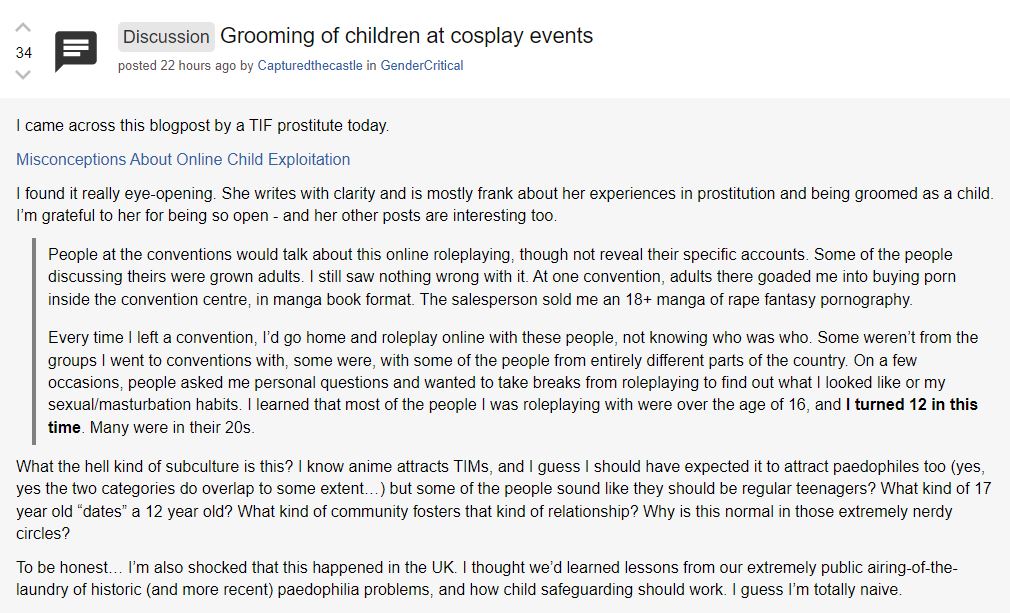
Talking about my history of being groomed leads TERFs like this to start ranting about trans women (for those unaware, “TIM” stands for “trans identified male”, which is an insult they use to misgender trans women). Of the many people who groomed me, none were trans women. There were trans girls present in these spaces, for certain, but many were being groomed themselves. Some by cis straight men, who seemed to make up the majority of the predators, but a not insignificant portion by older cis lesbian women or by gay/bi men or by older trans men of varying sexualities.
None of this is because trans people are some sort of cult, or because older trans people are grooming younger people to be trans, or because queer people are predatory… it’s because the group engaging in cosplaying, which for most of us was an excuse to crossdress, attracted queer people. If the group is mostly queer people, any predators within it are likely to be the same. Outside of groups I was in at the same conventions, the level of predation and pedophilia seemed to be the same or worse, but were perpetrated by vast majority cis straight men as reflects the demographics in the world at large. Queer people aren’t especially predatory; all my experience reflects is that we’re not immune by virtue of being queer.
TERFs mostly likely think that being sexually groomed and assaulted when I was young, some of those experiences by trans guys and in an environment with many trans people in general, turned me trans. The reality is that because I was so desperate to have the opportunity to be viewed as a boy for a day, I got into cosplay which led me into this grooming environment, and once I was there people took advantage of the fact I was so desperate for an outlet for my transness to groom me sexually. Me being trans came first, and it made me more vulnerable.
SWERFs will likely say that being sexually assaulted by the sugar daddy I had while homeless is what propelled me into escorting, or that the abuse that occurred to me in childhood made me act out and seek sexual validation. The reality is that needing money, due to being kicked out of home, made me see no alternative but to sell sex to be able to survive. The initial assault pushed me into online work, rather than selling sex in-person, because I was so traumatized… and then a desperate need for money was what pushed me back into selling sex again.
I am so tired of feeling like I have to justify myself any time I talk about this. I’m tired of thinking it about other people when they talk about their own abuse, too. Sometimes I’ll see a queer person post about having been abused as a kid, or another sex worker post about the same thing, and I’ll instinctively cringe and worry about what anti-trans or anti-sex-worker activists will do with their story and how they’ll twist it.
Whether we talk about our history of abuse or not, bigots will always find something to twist and will keep making the claims. People coming forward what they’ve been through is not a betrayal, it’s not detrimental to the cause. Allowing abuse to fester is what’s detrimental to queer people and sex workers.
Gay and trans people don’t have higher rates of being sexually abused as kids because that’s what “turned” us, it’s that we get targeted for our behaviour or any hint that we might be queer, by people who use our fear of being outed to silence us or think they can discredit us using it. Sex workers don’t have higher rates of being sexually abused as kids because that’s what caused us to get into sex work, it’s that people who are sexually abused are more likely to end up poorer or have a lack of family support, and therefore are more likely to need to financially support themselves by selling sex.
Part of what is so insidious about how this shame impacts us is that it means we internalize the ideas more and can often start to believe them even though they’re demonstrably false. I used to obsess over the idea that if my father did molest me when I was too young to remember, maybe that would explain why I ended up being a sex worker. Almost like I was looking for an excuse to absolve me of any responsibility. It took me a long time to rid myself of that, to confidently say that I can take full responsibility for my choices and not feel bad about them because I’ve done nothing wrong. Selling sex is not something I need to make excuses for. Nor is having gay sex, or taking testosterone, or living my life as a trans guy.
In others, I see this shame build up without resolution. People hate themselves for being queer or for selling sex and they place that blame on an abuser from their past. All things considered, placing that blame at the feet of an abuser seems like a relatively harmless act. Except that it leads to resentment of people who do not talk about having been abused, or who say openly that they haven’t been abused at all. I see people with this mindset that it’s okay to sell sex if you have to do it to survive, or you were traumatized as a child and are self-harming by selling sex as an adult, but God forbid someone does it as a job like any other.
Self-hating gays might discuss “same-sex attraction” as an affliction, and be horrified by the idea of people experimenting with their sexuality. The only justification they can see for having gay sex, which they absolutely do feel the need to justify, is that they’re inherently gay and always have been and it would be unfair torture to expect them to live heterosexually.
It is so much healthier and so freeing to give up on trying to make justifications for why you live the way you do. We need to deconstruct these ideas, work out whether what we’re doing is right or wrong, and if there’s nothing immoral about it then there’s certainly no need for excuses to avoid moral culpability.
For me, my shame was compounded when I saw people who’d been sexually abused who were not sex workers and were not queer and were happy. One of the huge flaws people point out in the argument that molestation turns people into sexual deviants is that not only do not all of the people they view as such have a history of sexual abuse, but also many people with histories of sexual abuse don’t end up becoming sex workers or trans or gay. Personally, I didn’t internalize this as a contradiction, I saw it as part of the point. I presumed the reason that it did that to me and not them was that I was mentally weaker than those people.
I don’t think my experiences are universal, but it’s so hard to know how many people relate to elements of my experience because we don’t talk about it. I don’t talk about it either, so it’s not like I can blame them for not opening up and therefore making me feel more safe to do so myself.
Sometimes I feel like shit and I’ll just read endless speculation about how a history of abuse fucks up people’s brains and makes them sell sex. SWERFs will talk about sex workers like we’re incapable of being self-aware and self-reflective. As someone who thinks far too much about my choices and my own thought patters, due to a lot of neuroses, that’s laughable to me. If only I were less self-aware. And yet, I read it. I ask myself to humour it, to see if I could prove it right as an exercise in showing myself how wrong they are even if I come from a starting point of trying to believe it (almost like re-creating trying to prove God and ending up an atheist, when I was a kid).
Being sexually abused and traumatized from it absolutely has an impact on behaviour. I have PTSD, and when it was much worse I did things like impulsively put up an escorting advert and sell sex to someone dangerous and boundary-pushing. Afterwards, I’d cry or scrub myself in the shower desperately, and think about how the abuse had caused me to sell sex and all these SWERFs were right about the way I was broken. The thing is… I was always propelled by my circumstances. I won’t argue that my history of abuse didn’t have an impact, it did, but I never would’ve started selling sex if it weren’t for the need for money. Rich people who’ve been sexually abused and are suffering with hypersexuality and compulsions aren’t putting up escorting ads, they’re going out and meeting strangers in ways that are still dangerous but don’t involve money changing hands. I did that, too, when I didn’t need the money… so clearly the money was the motivating factor for me selling sex and not the PTSD.
I never want to feel that kind of shame again, scrubbing at my skin in a hot shower and crying about how I’m in this position because of what a few abusive people did to me in my youth.
This shame around speaking about our own experiences is far more toxic than anything TERFs or SWERFs might do to twist our stories, and I won’t be quiet about my experiences out of fear over what they’ll say. I hope more people reach the same point in recovery that I have, where they can do so too. Selfishly, I hope they do to make me feel less alone.
 Jack Talks About Sex Work