TW: Discussion of sexual assault, including sexualized depictions of rape. I do not usually warn for individual articles, because my entire blog covers heavy topics, but I do not hold back from going in-depth in this article and rape/”non-con” kinks are a significant part of this discussion, with relation to sex worker characters in fiction. Also, there will be spoilers for Hazbin Hotel, obviously.
As soon as Hazbin Hotel’s first season released on Amazon, I had multiple people asking for my opinion on the sex worker character within it and his story line. Angel Dust is a gay porn actor who is highly flirtatious and open about his work, and he is a major character with an arc related to the coercive control he is engaging in sex work under. I saw the pilot of Hazbin Hotel years ago, found his character one-dimensional and thought he existed purely for shock value and sex jokes.
When I finally watched the first season that just came out, it was not what I expected. Angel Dust is given a deeper backstory involving his controlling pimp whom he is forced to work for, the way he shocks people and makes sex jokes is explained as a coping mechanism, and I even found elements of his portrayal to be relatable as a person who now sells sex whilst advertising myself as a man and who has experienced abuse from clients and controlling third parties.
If the portrayal of this character were simply the same sort of stereotype I see in other pieces of media, I wouldn’t feel compelled to talk about his depiction, but the show did surprise me.
The show is set in hell, with various characters who are different types of “sinners”. Within the framing of the show, it is made clear that the idea that all of these characters deserve to be in hell is flawed, and Angel Dust was not a sex worker prior to his death. It is not necessarily implied that doing sex work is morally wrong, though it is prevalent in hell and absent in heaven, because the set-up for heaven is criticized so heavily.
What is frustrating is that because of the nature of the premise, and the fact that the demons with power are genuinely horrific people, the owner of what appears to be the only porn studio in hell is a pimp who forces people to work for him via demon contracts and manipulation. Thus, almost all of the sex work we see in the show occurs under his coercion, with the exception of freelance work that characters may do independently and which Angel hints at. The setting and creation of this situation means that all of the porn workers are either victims or at least complicit in the abuse of their co-workers even if they are not active agents of it.
On top of the unsettling implications about the morality of the sex workers in the show, we also don’t have the opportunity to see any experiences in sex work which are neutral or positive. When Angel Dust speaks positively about his work, we know he is faking it.
Angel Dust is often referred to as “the” sex worker character in Hazbin Hotel, and I’m guilty of using that phrasing myself so that people know who I’m referring to, but the reality is that we see many other sex workers. The other sex workers are not major characters and most of them do not get speaking roles, however we see them on multiple occasions in scenes where Angel is filming porn videos with other people. Those who are also on camera fucking him are, obviously, also sex workers – and we see a significant number of these characters have sex with Angel at the porn studio when he is obviously terrified and doesn’t want to. These characters observe him be abused by the owner, know he is forced to work, and perform sex acts with him anyway without seeming to show any remorse. This makes many of his co-stars rapists, unless we are supposed to assume they are under equal levels of coercion.
This is not shocking when you see Angel Dust’s character for what he is; a vehicle for carrying as much trauma as possible, to endear the audience to him and evoke strong emotions which make them attached to the show. Being a porn actor is taboo, shocking, and making the character likeable and deep whilst piling trauma onto him creates a perfect storm for Angel to be a fandom obsession. Then, to seal the deal, depictions of the character being assaulted are sexualized just enough to titillate viewers who are aroused by rape fantasies whilst also maintaining plausible deniability, so that the creators and artists and actors involved can say the scenes are simply showing an accurate depiction of the character’s suffering.
It was obvious to me that many scenes of Angel at the porn studio are sexualized despite it being made clear that he is being forced, such as in the music video Poison which appears in the series.
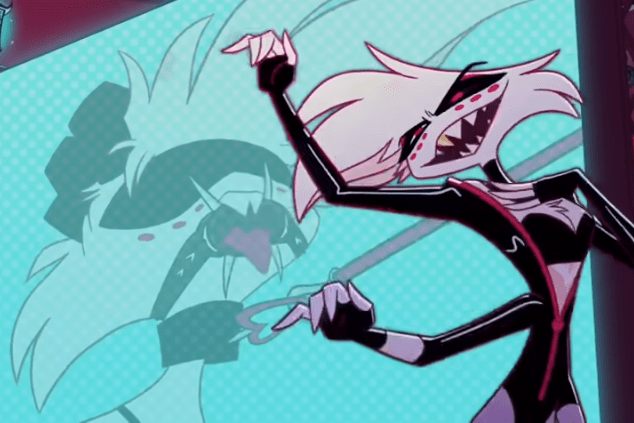

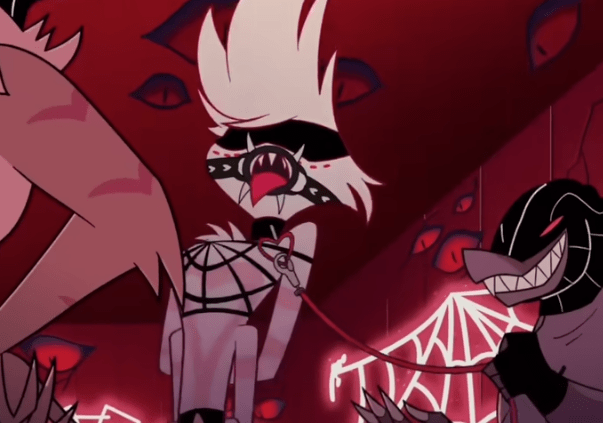
Rather than only appealing to how evident it seems to me that Angel Dust’s assaults are sexualized, and describing the ways the framing of the scenes make this clear, I’ll note that Raphielle (one of the artists who worked on these scenes, as a storyboarder) makes fanart featuring Angel Dust and Valentino where Angel is being raped, and has commented praising similar artwork. Callout posts like this one focus on exposing the rape/non-con art that this artist openly makes, but they get so wrapped up in their disgust for the art that I rarely see links be made to the content in the show itself. Instead there is endless scolding for the creation of the art outside the show, which harms no-one, and no useful critique is offered of how the watered-down content is presented to the public with minimal warning. If you see a rape/non-con warning on what you know to be porn, you can avoid it knowing it will be sexualized sexual assault… if you see a rape/non-con warning on a random TV show, you have no idea if it will be sexualized or not.
Vivziepop, the creator of Hazbin Hotel, advertised the music video by making sex jokes rather than by talking about how heart-wrenching it is. And of course she would, because it’s good advertising and the music video is intentionally sexual and meant to arouse to some degree!
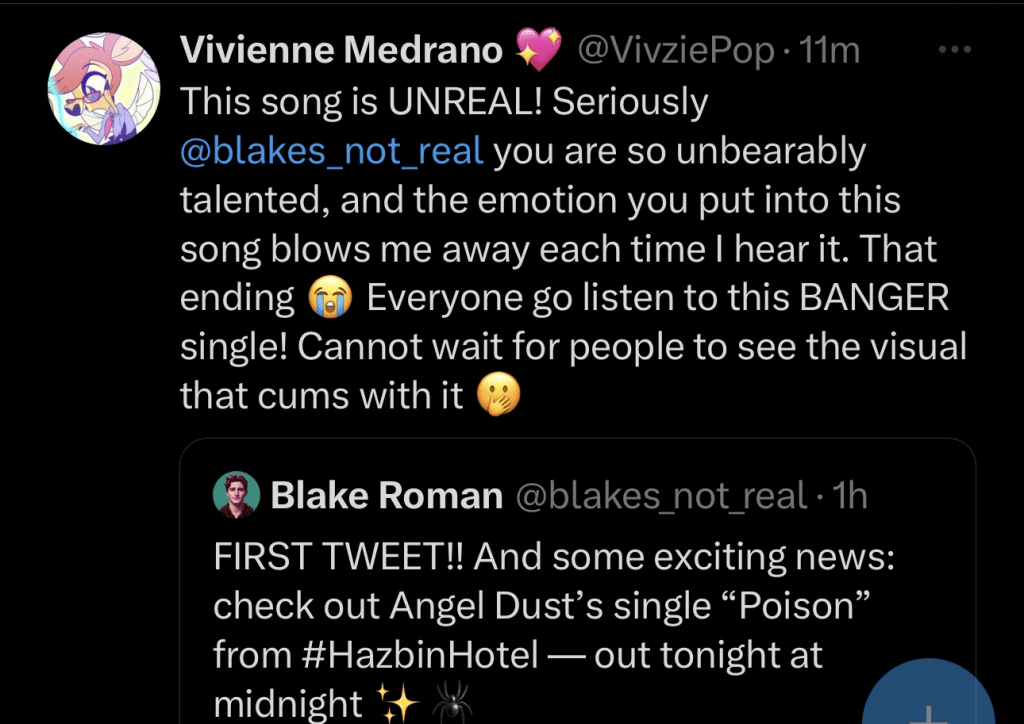
The ways the scenes where Angel Dust is assaulted are framed are not, in themselves, something I seek to criticize. I’m immensely frustrated by people denying that’s what’s happening in those scenes, which I’m sure many people do because they’re defensive about the show they like, because refusing to acknowledge what is an obvious rape/non-con kink scene causes the show to be mislabelled and people to come across triggering content with the belief that it’s a sensitive depiction rather than a sexual one.
I do not fundamentally think it is morally wrong to sexualize traumatic or horrific acts within fiction. Ravishment or rape fantasies are very common, not because people want to be raped (you cannot desire to be raped, because rape is specifically non-consensual) but because the human brain often mixes our fear and arousal responses together. Many people are attracted to things because they fear them, and these fantasies are purely hypothetical. There is no reason to believe that those who enjoy non-con or rape fantasy content are more likely to carry out or support sexual assault in real life. Instead, they’re disproportionately likely to already be victims.
My fascination with Angel’s depiction comes from the juxtaposition of these scenes made to prompt arousal from at least some viewers with the scenes where Angel’s sexual trauma is treated in a serious and genuine way.
In episode 4 of Hazbin Hotel, where the rape sequence plays in the upbeat musical number, we also get a realistic portrayal of PTSD for survivors of sexual abuse. There is a long scene where Angel Dust is shown to seek further harm by repeating the cycle of abuse in a way he can somewhat control, finding himself in the company of dangerous men who seek to drug and assault him further. We see him play along despite knowing these men want to assault him. Angel Dust breaks down when explaining that he is abused no matter what he does, so he prefers to have some level of say over it. He cries and talks about desiring to become so broken that his abuser no longer wants him. There’s a musical number after this, the balm to the open wound that Poison creates, called Loser, Baby. It feels like a genuine demonstration of understanding of Angel’s feelings about being trapped in forced sex work.
Neither part of this depiction erases the other. Hazbin Hotel contains an incredible scene and song which I found to be one of the most relatable portrayals of a sex worker who has been coerced that I’ve ever seen – one which refuses to downplay the realities of PTSD and does not play into the perfect victim ideal – and it also contains a scene which seems designed to prompt fans to make non-con fanart and fanfic and use as fuel for rape fantasies.
Both of these things existing in one place is just so strange to me. The show would be much worse without Angel in it, as a compelling character who I am invested in, and I am seeing large numbers of people have discussions about sex work who otherwise would not be. It’s not good representation, exactly, but it’s far from the worst I’ve seen. I don’t want to recommend that people watch it and I also don’t want people to write it off because it’s an adult cartoon that seems like it will be all sex jokes and gore.
Cards on the table: I really enjoyed Hazbin Hotel, despite the fact I put off watching it because I expected to hate it. I watched it through several times in the space of a week after my first watch. Angel Dust’s storyline was compelling to me. I’ve listened to the song “Loser, Baby” perhaps a hundred times now, and to “Poison” at least a dozen. It’s a fun show that has heartfelt moments and there are brief segments where I actually almost feel seen as a sex worker in a way I never do in mainstream content. Outside of fiction written by sex workers themselves, these characters usually scream their inauthenticity at me, and that didn’t happen with Angel Dust.
I’d prefer that the scenes where the sexual trauma is sensationalized and sexualized weren’t framed the way that they are in the show, but at the same time I’d rather have them there and keep this representation than lose the character all-together.
As for the discourse around this character and the show, I’d like to see more people engaging with the words of actual sex workers. Regardless of your thoughts on a fictional character from a cartoon, actual sex workers are frequently the victims of real assault and criminalization and censorship, and for too many people their only references for our needs and experiences are the characters they see in the media they consume. I hope that controversy around Angel Dust prompts at least some people to learn about the cause for the full decriminalization of sex work and sex workers’ rights.
(If you’re interested in reading about the spectrum of experiences that transmasculine sex workers have, rather than just my thoughts about sex worker characters in media, please check out my current project Working Guys: A Transmasculine Sex Worker Anthology!)
 Jack Talks About Sex Work