
A portion of the negative beliefs I had about sex workers, before I began selling sex myself, came from the media I consumed. There are many passing references and jokes about people who sell sex, even in shows considered acceptable for children when I was growing up, like the Simpsons or Futurama. Rather than delving into those surface-level depictions and characters appearing in the background, like in prison cells in Brooklyn 99 or scenes which take place in strip clubs, I want to talk about sex worker characters that appear in different forms of media and their narrative uses.
To have better sex worker representation in the future, we need to understand the failings of the current ways these characters are designed and treated. Falling into these tropes doesn’t necessarily mean the characters are all bad, and I adore some of them despite the flaws.
Evidence of Societal Breakdown
When creating a dystopian setting or showing a society on the brink of collapse, sex workers are often used as a way to demonstrate corruption or immorality or the extent of poverty. It’s a shortcut to showing the desperation that characters in the background of the setting are dealing with, with the idea that they’d “turn to” sex work or be forced into it because of the circumstances of the story.
In Game of Thrones, sex workers are regularly used to demonstrate the immorality of other characters. Having a man go to brothels or surround himself with a harem of women hired to serve him sexually is supposed to tell us of his depravity and how dangerous he is.
In sci-fi stories and future settings, the sex workers are often also androids, to meld together the fears people have around technology with these other themes. You see this in Cyberpunk 2077, Bladerunner, Detroit Become Human, A. I Artificial intelligence… far too many pieces of media to name. There are frequently brothels populated with androids who are selling sex, who are often sentient but treated as sub-human and controlled to a greater extent than humans can be. They exist to be an exaggeration of the trauma real sex workers suffer when we are exploited by third parties, where their autonomy and control over their actions within the constraints of their situation are taken from them by replacing free minds with software and circuits.


A. I. Artificial Intelligence (2001) tries to use the main android sex worker character (played by Jude Law and forever imprinted in my brain from when I watched it as a child) to comment on the ways sex workers are objectified. The issue it has, like many pieces of media trying to do the same, is that it fails at respecting sex workers’ choices or the things which lead us to sex work. Instead, the story creates fully-formed characters with no childhood or past or financial circumstances, who are literally designed and built for sex.
Gigolo Joe (yes, they really named him that!) is a male sex worker whose clients are shown to be exclusively women, which is a rarity in sex work. While re-watching this film recently as an adult, I expected the portrayal to be bad. The framing wasn’t good, but Joe’s comments about sex work pleasantly surprised me.
Gigolo Joe’s character, though I’m sure not intentionally, is coded as trans. The first time we see him with a client, he spends his time soothing her with regard to his robot genitals which she is worried will be different than she expects from “orga” (human) men. Then, whilst seducing his client, he claims “once you’ve had a lover robot, you’ll never want a real man again.” The front he puts on for these clients is not dissimilar to what I’ve seen from other sex workers I know, or the personas I have used for myself.
To demonstrate how he speaks of his own work, as a bit of his sales patter and a way to speak directly to the audience about his portrayal, I’ll leave you his short monologue given to some young men when he needs a lift in their care:
“There are girls your age who are just like me. We are the guiltless pleasures of the lonely human being. You’re not going to get us pregnant, or have us over for supper with mummy and daddy. We work under you, we work on you, and we work for you. Man made us better at what we do than was ever humanly possible. If you can manage us a lift to Rouge City, all this, and much, much more, can be yours.”
Within Detroit Become Human, the control over the androids is even more extreme. Until the moment they become “deviant”, they only follow their programming and are physically forced by it to obey all orders from humans. Inside the strip club and brothel named the Eden Club, the sex androids are entirely enslaved and have their memories wiped every 2 hours. In the game, the most brutal scenes are reserved for a pair of lesbian sex worker androids who become sentient and “deviant”, the Tracis. The player not only has to fight them in their underwear, but whether or not you make the choice to execute them with a bullet to the head, one of them will recount her disgust with her clients and at being forced to sell sexual services.
If the player chose to kill them, the game allows you to rip the head off of one android and show it to the other to get her to talk. The game has many brutal scenes with android gore, yet this one still stands out. They are supposed to be viewed by the player as the most extreme example of subjugation and enslavement of androids, and the game allows you to mistreat them further when you play in a manner which results in a worse ending. The worse the society is, the worse the sex worker stand-in characters are treated.

Rather than using androids, games like Dragon Age and Baldur’s Gate 3 show the way society is collapsing or mistreating certain fantasy races by using sex workers. In both games, you find elves in the brothels who will comment upon how racism in the setting drove them to work there.
In Baldur’s Gate 3, upon entering the brothel Sharess’ Caress, you can get a quest from the madam to search for a missing dominatrix names Ffion. If you take up the search, you find Ffion dead, and the madam of the brothel is completely indifferent to the loss of her life except for how this loses her money. This leads into a plot point about how many people in the city are being murdered, while only the rich have their murders investigated at all or are protected if they become known to be targets. Our introduction to this idea is a sex worker, in my opinion, because the viewer is supposed to be the least surprised by her murder so that we don’t immediately expect a greater conspiracy.
The reality is that sex workers are all around us, existing in every country and society. The circumstances and numbers do shift, given that economic necessity is a large contributing factor to people selling sexual services, but the presence of sex workers is not limited to the lead up to societal collapse. Sex workers existing in any setting is mundane.
Erotica and Sexual Excitement
Instead of sex workers being used to tell us something about the story’s setting, or as fodder to demonstrate another character’s promiscuity or dangerousness with how he treats them, sometimes the presence of a sex worker character is clearly for the titillation of the viewer.
There’s nothing wrong with characters or scenes being created purely for their attractiveness. What is frustrating is that sex workers are often treated as objects of desire whose sole purpose is sex, and that they are denied having complex personalities. If we appear in erotica or as a character to add sexual intrigue or tempt another character, our only actions are in service of flirting and seducing, sometimes as if it is our nature rather than something we do to earn a living. The act that sex workers put on to advertise to clients is taken at face value and the character is one-dimensional.
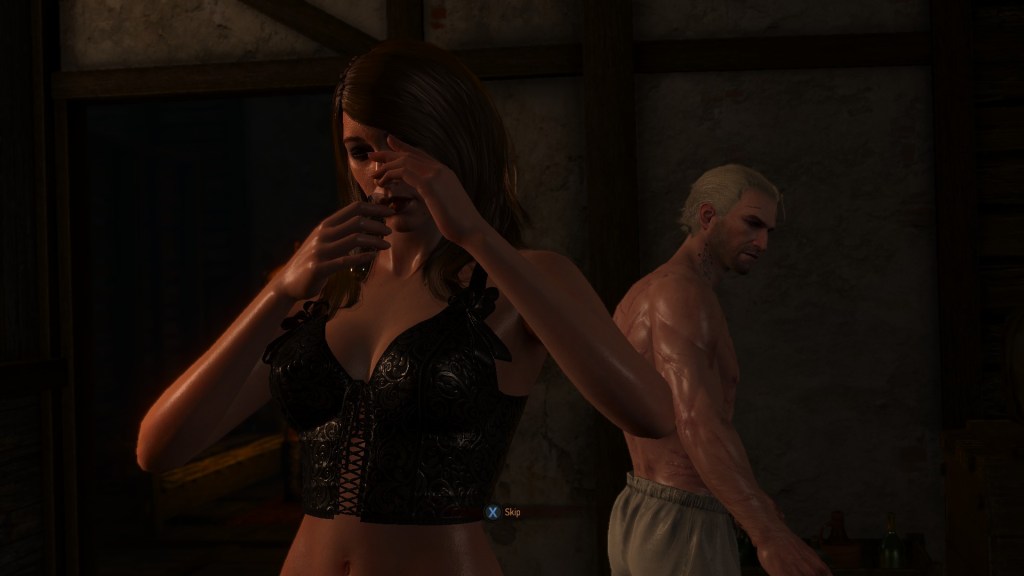
In the Witcher TV series (as well as the video games), sex workers exist to give us some extra sex scenes and shirtless women in between the sex scenes we get as a part of the plot. They’re window dressing for the displays of orgies and the main romance.

Girlboss Hookers
I’ve seen some shows and games and books recognize the poor treatment of sex workers in other fiction, and to try to subvert these tropes. Many of them overshoot and end up playing right into the “Happy Hooker” narrative.
With friends, I jokingly call these kinds of depictions “Girlboss hookers”. They’re almost always women, because the idea of a confident and happy heterosexual Gigolo or gay rentboy isn’t as subversive as a woman of any sexuality enjoying selling sex. Gay men are often painted as sexual deviants who are sex-crazed, and straight men do not face the same level of stigma around selling sex. Accounting for the expectations that women should be modest and not be promiscuous, and the misogynistic whorephobic attitudes of most people, having a female character who loves her job selling sex is more shocking to the general public.
The shock, however, isn’t really the point of this kind of depiction. The Girlboss hooker character exists with the purpose of signalling that the creator of the piece of media is a progressive who supports sex workers, and who thinks sex work can be empowering and fulfilling.
I’m not interested in arguing over the false dichotomy that states sex workers are either empowered or exploited; we are often both, at the same time, while selling sex. A piece of media which only shows positive experiences in sex work is upholding this dichotomy just as much as trauma porn about the miseries of prostitution is.
Though I thoroughly enjoyed the Harley Quinn TV series, the scene with a dominatrix sex worker really grated on me. Bane accidentally stumbles upon a sex worker who is about to meet a client, mistaking him for her duo partner (another sex worker she will be working with), and he joins in on a small penis humiliation scene with her. This is played for laughs, but in a very short space of time Bane learns the sex worker’s real name and that she genuinely has similar proclivities to her work persona. Beyond the fake name, she is shown to be entirely herself during sessions, and to love her work. She very quickly invites Bane over to her place, wanting to have sex with him.

Empowered sex worker characters are often dominatrixes, rather than full service sex workers who have intercourse with their clients, because it’s an easier sell to the audience that the sex worker is in control. She has the power over her clients in the sessions, maybe even tying them up, and we are supposed to see her as confident and skilled and not at all exploited. Her enjoyment of the work is made more believable because she degrades her clients rather than being fucked by them, which even supposedly progressive depictions of sex workers find harder to frame as always being enjoyable.
Another dominatrix sex worker character who is shown as loving her work is Irene Adler in BBC Sherlock. She works for herself, has famous clients up to and including a princess, is a lesbian who sadistically punishes men and women alike during her work, and she is extremely confident with her own nudity and sexuality. Although her agency is eventually taken away from her in the story, and she falls for a man despite expressing that she usually only has interest in women, it is never questioned that she loves her work. Her clients are not a threat to her and she always has the upper hand over them. Even the actress, Lara Pulver, said she found the role empowering!

Although a lot of sex workers are strong and confident businesswomen, they are not invulnerable. Even among dominatrixes who have similar kinks in their personal lives as those they enact while working, who are already a very small subset of all sex workers, there are risks to the job and ways they are mistreated or harmed by clients. Girlboss characters can’t be seen to contend with issues like criminalization or assault in a realistic way, because to do so would be to undermine the empowerment narrative.
A Source of Trauma
Audiences love a character with a tragic backstory, and a history of selling sex works very effectively for this purpose. It might be a twist in a horror plot, like in Last Night in Soho, or a backstory eerily close to that of someone controlled by a pimp like with Astarion from Baldur’s Gate 3, but the purpose remains similar. We are supposed to understand, without the need for details, that a character has sexual trauma and all of the associated fears and responses.
Lots of people also like viewing a character experience huge amounts of trauma, either because they enjoy it in a sadistic sense or as a safe way to reckon with the kinds of harm they have experienced for themselves. Seeing a character go through severe sexual trauma, and then be comforted or cared for afterwards, can be soothing. The entire hurt/comfort genre exists in fanfiction for this precise purpose. Enjoying seeing a character suffer isn’t morally bad, because they’re fictional, but consistently seeing prostitution or porn used for this way can make it hard to believe sex workers when we don’t have a uniquely traumatizing experience.
Hazbin Hotel uses the character Angel Dust, a gay sex worker, for these kinds of scenes. The sexual abuse of the character is sensationalized and shown to the audience in the form of captivating and raunchy musical numbers. The audience is encouraged to empathize with him, but also to delight in the depravity of it and the shock of seeing such a large amount of sexual trauma in such a short space of time.




Angel Dust works in porn scenes with other performers, all of whom we see as participants in his abuse who seem completely indifferent to his obvious panic and discomfort. These additional sex workers are window dressing, bodies who exist in the scenes so there are groups of men to abuse Angel, seemingly with no consideration for how this frames Angel Dust as a special case who is worthy of our sympathy because he doesn’t want to be there.
If you choose to get close to Markus’ love interest, North, in the game Detroit Become Human, finding out her backstory, you will discover that she was a sex robot forced to work in an android brothel. We never get the specifics of her experiences, beyond a moment where the player is told she ran away after killing a client whose home she was sent to. From this small amount of backstory, the player is expected to recognize that her hatred of humans stems from her experience as a sex android.
In The Alienist, the sex worker characters are killed by a serial killer who is targeting boys selling sex, most of whom are underage. There are graphic scenes of sexual violence and skin-crawling depictions of their trauma. Despite prostitution and the targeting of sex workers being the main plot of the show, we don’t see prostitution treated as anything more than a scourge which causes devastation and death. As if these portrayals alone weren’t enough, they push things even further by having the boys be forced to sexually assault an adult man in one scene. Although sex workers still exist in the modern day, their suffering is contextualized in the very late 19th century to allow fans to engage with their pain in a way that feels safe and left in the past, with the horrific portrayals being totally disconnected from the experiences of sex workers now.
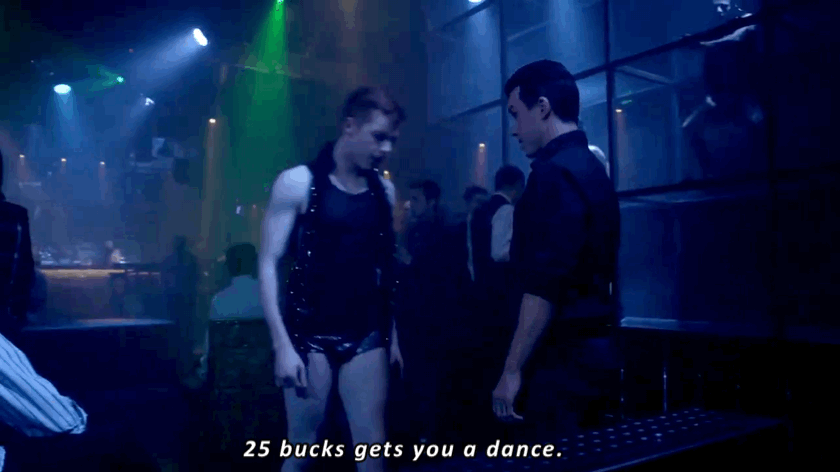
In plenty of long-running shows, a character will have a brief stint in sex work, much to the horror of the surrounding characters. This kind of character arc is used to highlight the instability or vulnerability of a character, like with Ian from Shameless. When he is barely 16, he has his first severe bipolar episode and disappears, only to be found working as a stripper and selling sex in a club. His family and boyfriend desperately try to convince him to stop, to save him from being exploited by much older men, and after his boyfriend Mickey punches his way through a few clients they’re able to bring him home. The entire purpose of Ian doing sex work, for the narrative of his and Mickey’s relationship, is so he can be the damsel in distress that Mickey rescues… soon ending up in a psychiatric facility so they can be split up again for their constant on-again off-again relationship.

Outside of traditional fiction and into the realm of fan-made works, giving a character a history of selling sex or having them be a sex worker is a common choice in fanfiction intended to hurt the character as much as possible. Torturing a beloved character is a common pastime of fanfiction writers and having the character sell sex is an easy avenue for plotlines ending with sexual assault or kidnapping, as well as being a way to create a fast and easy power imbalance between two characters being ‘shipped’ together in intentionally unhealthy ways.
Shock Value Side Characters
Want to spice up your stagnant plot? Sex worker characters can also be used as side characters for pure shock value!
In later seasons of House M. D, House is wallowing in being single after things end with his love interest Cuddy. The viewer finally got scenes of them together after a long will-they-won’t-they plotline over several seasons, so after the break-up there needed to be something to fill that space. In comes House’s “favourite prostitute” Emily, who pushes House towards a love interest who is more acceptable, providing drama and intrigue with her mysterious personal life.
In GLOW, which actually has a fairly balanced and considerate depiction of a stripper with one of the wrestler characters, Yolanda, a gigolo named Paul is brought in for shock value. The scene where he is revealed to be a sex worker happens with another character believes she has been mistaken for a sex worker by him, only to find out that actually he’s the one selling sex and expecting payment from her! Whacky hijinks, sure, but incredibly unrealistic given that sex workers aren’t in the habit of sleeping with people without asking for payment upfront or clearly communicating the terms of the agreement.
The Boys gives us a sadomasochistic sex worker with Gecko, a man who is able to rejuvenate his body and even grow back limbs when they are cut off. He offers to do this for clients who are sexually excited by the idea of removing a limb from someone or doing serious bodily harm. We’re supposed to assume Gecko is selling sex when this is revealed, only to discover he’s actually selling the right to severely harm him for clients to get off to.
Then there are shows like Glee, which go on for so long that they need to keep finding new plotlines they haven’t done yet, which resort to giving characters plotlines which revolve around sex work just to give the viewer something fresh. They have Sam becoming a stripper to make a living to support his siblings whilst they live out of a motel room, a secret which is revealed explosively after various characters suspect he is having affairs with other characters or that he is hiding being gay before the reason for his odd behaviour is revealed.
Glee uses the sex worker storyline again, with another straight male character, when a love interest for Rachel is revealed to be selling sex to older women. Brody’s cover of How to Be a Heartbreaker with scenes of him seducing older women, in a conspicuous way that makes no sense for him to be doing as someone selling sex in a country where it is illegal (not to mention the illogic that he could make a living purely freestyling, with no advertising), is burned into my mind forever now.
Well-Rounded Depictions of Sex Workers
Due to my own experiences in sex work, I’m always craving some good representation on screen. I don’t need the characters to be good people, or for them to obtain positive outcomes or happy endings, but I do want to feel like their words are authentic. If I’m thrown out of the moment by situations that don’t make sense or things a sex worker claims about the work that don’t ring true, I find it so much harder to enjoy. Plenty of sex workers are messy, or are exploited, or exist in difficult circumstances! But we are also more than our work.
There’s Lafayette from True Blood, a gay man who works as a cook and sells drugs, sex, vampire blood, and starts a plethora of businesses as a jack of all trades on the side, to get by in a town full of financial struggle. He makes morally dubious choices and is fiercely loyal to his close friends. His character has depth and his presence is consistent. I’ll make no secret of how much I adored his character; he was by no means a perfect man, but his complexities make him deeply relatable. I was always rooting for him.

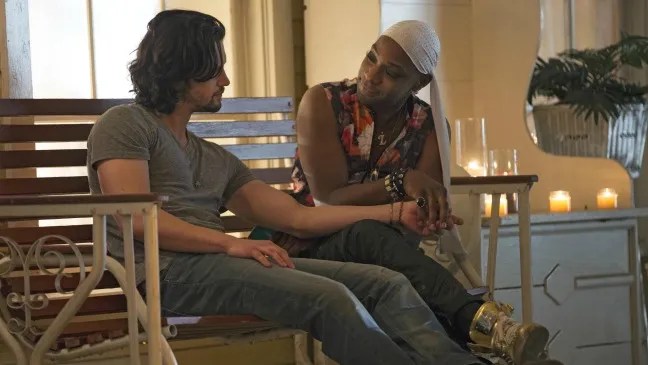

When his sex work is thrown in his face during a confrontation, by Pam (previously a brothel madam and sex worker herself), he responds to being called a prostitute by saying, “Oh, don’t get it twisted, honey. I’m a survivor first, capitalist second and a whole bunch of shit after that. But a hooker dead last!”
These words that reflect how I feel about being a sex worker at this stage of my life, yet they are still accurate to how many sex workers feel. I’m sure he wouldn’t use a label like sex worker for himself, and he uses “hoe” and “hooker” as joking pejoratives with friends in the same way many people do with the word “bitch” – and it’s completely believable. Many people who sell sex view it in exactly this way, and take on no labels or politics associated with the work they use simply as a means of survival.
The same show gives us a look at prostitution in the early 1900s too, with Pam being the madam of a brothel before she becomes a vampire, and we hear about her history of selling sex prior to that. There are sex workers in the clubs she manages in the 21st century, who she interacts with from a similar position of power. The sex workers don’t disappear after they’ve fulfilled a purpose – they’re an integrated part of the world and are not degraded by the story for selling sex.
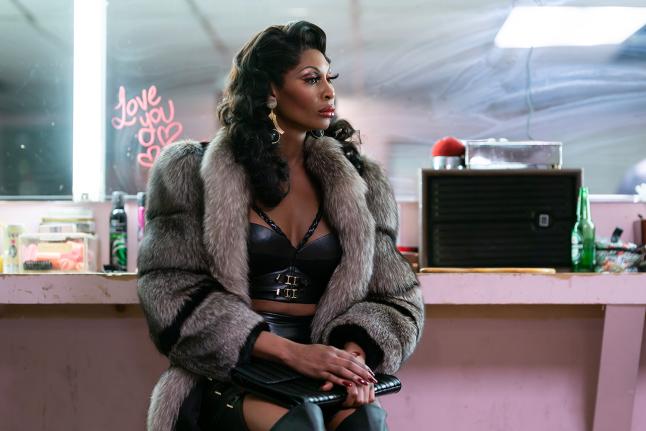
Pose is a show with incredibly well-rounded sex worker characters, and many of them, from Angel (who is played by Indya Moore who was also a sex worker herself in real life, so it’s not surprise her acting was wonderfully authentic) to Elektra to many others. The show has so many characters who at least dabble in sex work, with many using it for their sole income, that we get a huge variety of storylines and experiences. We see women who make larger sums as high-end escorts, like Elektra who sells sex to afford transition-related surgery and funds her entire ‘house’ (queer group engaging in drag balls), and we also see Angel and other women selling sex on the street to meet basic needs or afford drugs.
Pose is quite unique in this way, because we see a sex worker community rather than a sole sex worker character. Through this, we’re able to be privy to conversations about the realities of selling sex, rather than what we often get which is sex workers’ marketing patter to their clients and stilted conversations with other characters who do not understand their experiences.

How should sex workers be portrayed?
I recognize that my feelings about being a sex worker are not universal, and I don’t want to see portrayals of sex workers be forced to follow a template. I don’t even hate all of these tropes, or thing they should never be used. I’ll admit to Shameless being a real guilty pleasure for me, and to getting satisfaction out of Ian’s sex work storyline. Astarion’s backstory in Baldur’s Gate fascinates me even though it’s barely a hair away from being a sex trafficking whump fanfiction storyline. I find the song by Angel Dust in Hazbin Hotel, Poison, to be ridiculously catchy! These portrayals being flawed does not mean I believe they’re without merit.
Pose will always have a special place in my heart for its frank and honest portrayal of what the lives of sex workers were like during the 80s and 90s, with some embellishments being made to give characters some happier endings than they might have gotten in reality. The fact they included actors with actual experience of sex workers is a great addition to the amazing writing there. I would love to see more of that, with scripts written by sex workers or at least checked by them, advising on the production and being paid for their time and work.
What I want to see is not writers who avoid tropes, or who tick traits off of a checklist when making a sex worker character to be sure that they are inoffensive. Instead, I would love to see them educate themselves about our lives so that they write about us accurately. If they’re making a story that’s sex worker wish fulfilment, imagining a world where it’s all empowerment and sex workers don’t face the oppression we do in real life, I want them to admit that’s what they’re doing in the work. Sex workers often like wish fulfilment too! Shit like Pretty Woman doesn’t cut it, because clients aren’t generally desirable to the sex workers who see them and being whisked away by one isn’t the goal.
Give me more sex worker characters in the fiction I watch and read in general. At least them, just by the numbers, there’s more chance of me finding a few portrayals that are good.
 Jack Talks About Sex Work
One thought on “Fiction About Sex Workers”