
When planning for top surgery, it can be really daunting. Any kind of surgery is a scary prospect and no matter how many videos you watch or how many people you talk to, you’re never going to be able to perfectly prepare for everything that might happen. Even after you’ve researched your surgeon and decided on your ideal surgery type, made a list of everything you need to pack and arranged time to recover, there still might be some things that’ll catch you off-guard. There’s also a lot of misinformation out there about top surgery.
We’ll go through some frequently forgotten advice and bust some myths about top surgery.
Take a lot of pre-surgery pictures, from a lot of different angles!
Even if your dysphoria now is extreme, it’s so valuable to have comparison pictures. It’s very likely that as time passes after top surgery, you’ll get less uncomfortable looking at old pictures of yourself and it won’t make you anywhere near as dysphoric because you don’t have that body anymore. Once you get to that stage, it’s likely you’ll want to be able to make comparisons.
Immediately after surgery, you’ll be bloated, and so you’ll want pre-surgery pictures to be able to compare to during the initial stage where you feel like you’re shaped in the proportions of a chimpanzee.

The bloating will go down eventually and you’ll be back to the proportions you’re used to!
For transmasculine people who had a small chest pre-surgery and who experience post-op swelling, you might be disheartened and feel like your surgery didn’t change things as much as you hoped initially. This may be especially true if you have drainless top surgery where you might get more swelling, or if you’re fat and opted to keep some amount of tissue to fit your body type, or if you prioritized nipple sensation and kept some tissue for that reason. While you’re waiting for the swelling to go down, you can compare to your pre-op pictures to reassure yourself as the swelling lessens!
Also, perhaps one of the sillier reasons you might want to keep pre-op pictures is so you can make comparisons later. The idea of a transition timeline in images might not appeal to you now, but that doesn’t mean it never will. If you never want to post the images, then you’ve still lost nothing by taking them.
Don’t waste your money on special scar creams
Lots of trans guys swear by different creams for their scars, boasting amazing results and showing how faded their scars are. The truth is, everyone scars differently and some people naturally scar almost invisibly and some people have raised and red keloid scarring and it’s just a natural variation regardless of what they do. One person using a cream and having near invisible scarring doesn’t prove that cream works, it just tells us that person scars that way.
What’s known to be effective with scars, including the kind you get from an operation like top surgery, is rubbing motions and pressure along the scar. You’ll want some kind of lubrication for that, which can be any kind of moisturizer or cream or lotion or oil or even lube that’s unscented and doesn’t contain harmful additives. The only thing that seems to have any added benefit is silicone, so if you want the absolute best possible results then look for a gel with silicone in it to use when you massage your scars and/or some cheap silicone strips to put on them.
If having less visible scars is important to you, there are a lot of things you can do to maximize your chances and some are more expensive than others. You can also ask your surgeon about giving you scars which follow the line of your pectoral muscle to make them easier to hide, to give yourself the best shot at a chest that will pass for cis at a glance if you’re able to attain scars that blend in.
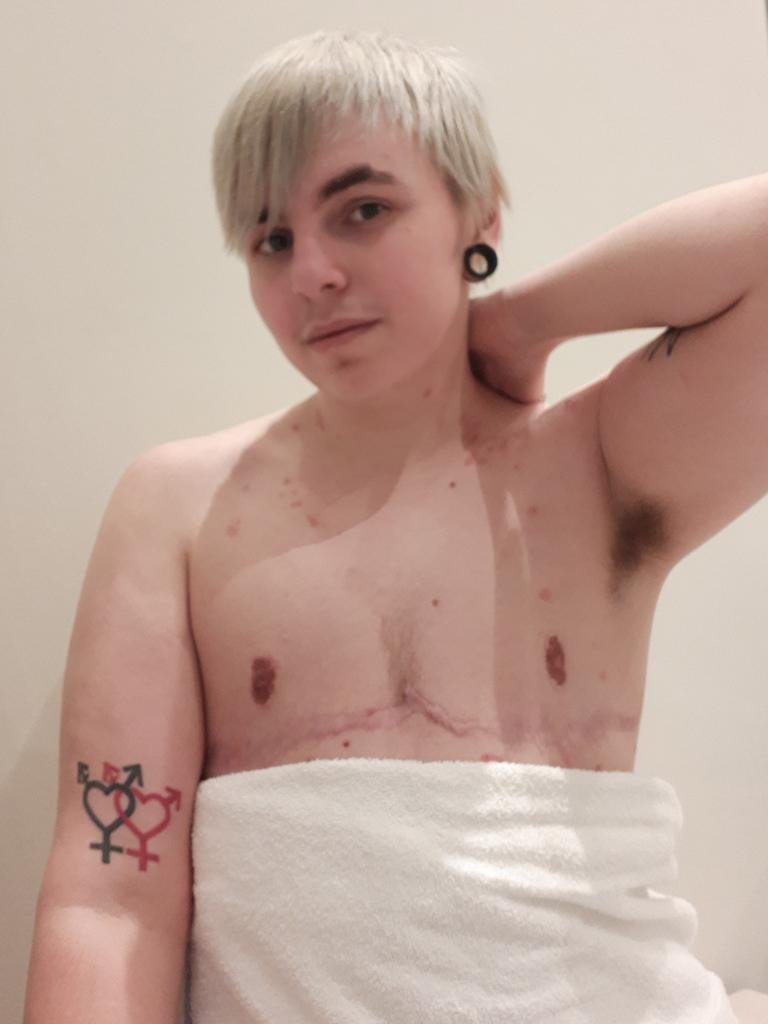
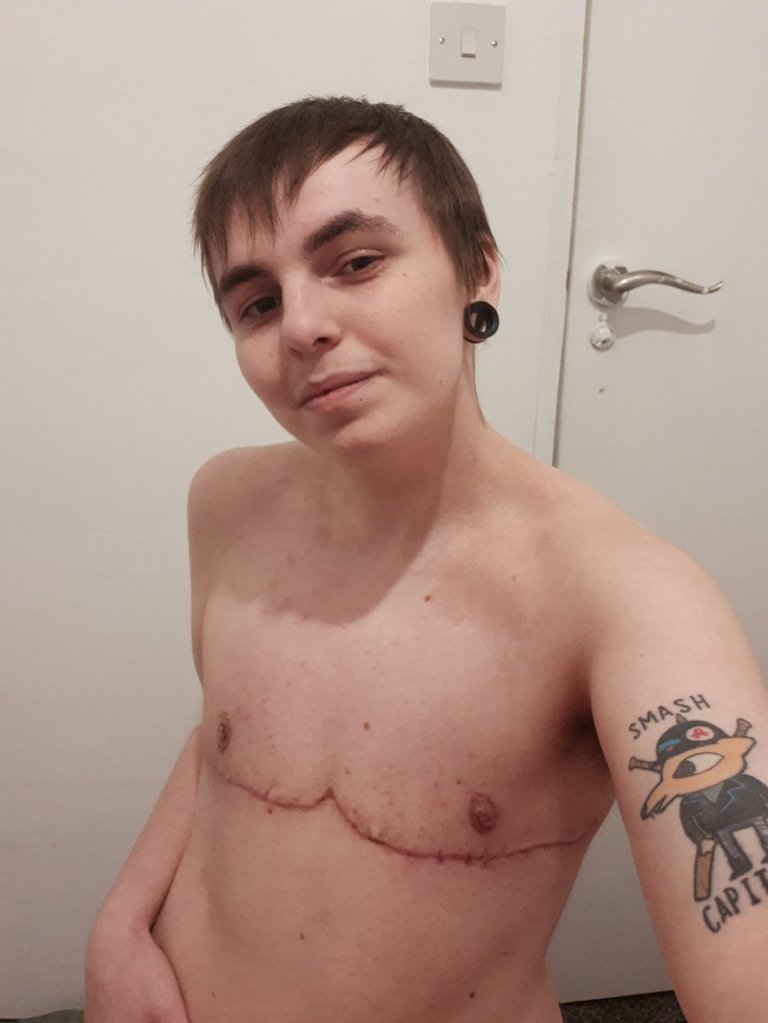
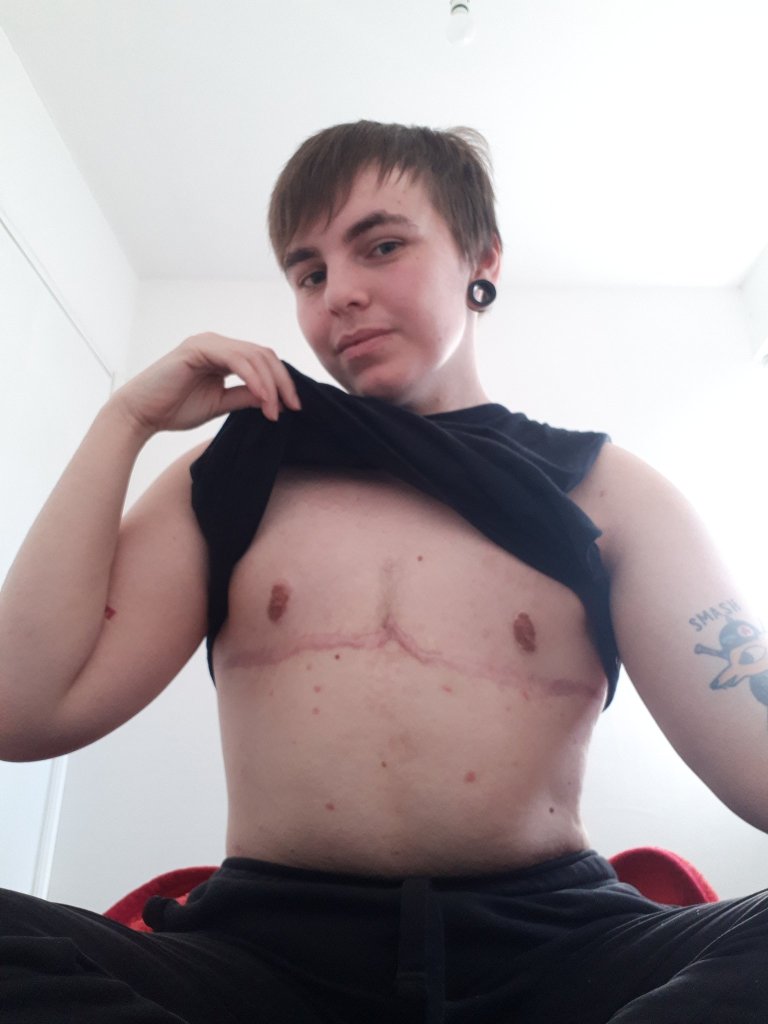
This image shows you the placement of my scars, which run along the bottom of my pectoral muscles. If I were to build the muscle in my chest, they would sit underneath and be partially covered in shadow. You can see I have raised keloid scarring in the middle of my chest, but the rest now lays flat and has gotten paler on me since surgery and matches my skin more.
One way to end up with less visible scars is to minimize movement after top surgery to keep them as thin as possible. This means lifting your arms as little as possible, avoiding strenuous activity beyond when you’re cleared for it and waiting until the scar properly forms at around 6 weeks before you do any sort of stretching or lifting. This, alongside massage and the use of a silicone gel, increases your changes of flat scars that are close to your skin tone.
Some other options, though they’re much more expensive, are steroid injections into the scars to flatten them and laser treatment to make the scar blend in with the skin more. Laser treatment can take many sessions before you get the full desired effect, but it does have a big impact.
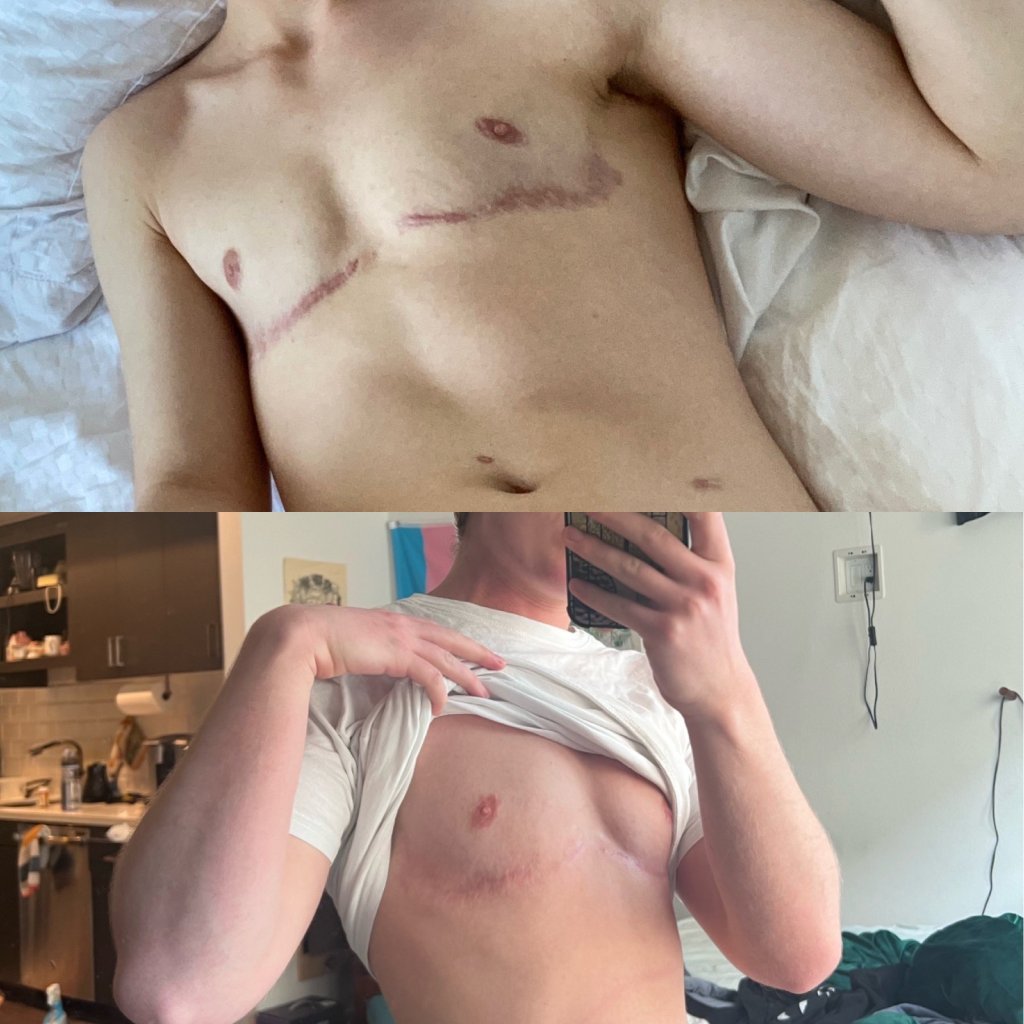
This image shows @noahwaybabes (18+ account) after 8 laser treatments and some steroid injections to flatten the tissue, with before and after pictures for comparison.

(Note: depending on whether you have dark or light skin, you might want to use a different type of laser to get a better effect, so make sure to ask about this when seeking laser scar treatment!)
Practice doing things without using your arms
The main issues you’ll hear about with regards to your movement will be about the fact you can’t lift your arms to reach things. While this is annoying, not being able to move your arms very far is an even bigger problem for actions like sitting up from a position where you’re lying down. It’s a good idea to practice this before you get top surgery, to see how difficult it is to lever yourself up without the use of your arms.
If it’s hard for you to get out of bed using just core strength (which might be lowered after surgery too), then make adjustments to your bed like adding more pillows so that you’re half-way to sitting even while sleeping. Try gripping the edge of your bed with your legs as you try to sit up and then stand.
You can add bits of fabric to long door handles too, if they’re higher up than the height of your hand when your arms are at your sides and your elbows are bent 90 degrees to leave your hands in front of you. Then you can pull on the fabric instead of the handle, which is also useful for giving you extra leverage so the door requires less twisting or force to open all the way.
Have a plan for post-op depression – particularly combatting TERFs who might harass you for it.
The prevalence of post-op depression is sometimes overstated, but equally because some people speak only about the euphoria of having a flat chest after surgery not everyone is prepared for the after-effects of surgery. Getting top surgery isn’t a special case when it comes to post-op depression, it’s actually common after surgery in general. This can happen as a possible side-effect of the anesthetic or as a response to the amount of energy it takes to heal from surgery.
Groups who oppose transition care will often latch onto any discussion of post-op depression from trans people to act like it is regret and evidence of desire to detransition. It is not, and you should not feel ashamed of any depression you feel in the immediate aftermath of surgery. You can be happy with your results and also suffer from the physical side-effects of surgery which have some mental impacts. It will pass and you should ask for support from those around you if it happens to you. Be prepared to explain this is a side-effect of surgery and have resources prepared, if you might have to discuss this with people who are not fully supportive of your transition and who might see this as evidence it was the wrong choice. If you feel up to it, logging your feelings can be a good idea. Write in your journal about how you feel about your results and also how you’re feeling generally, to allow yourself to see if any upset is related to your results or whether it’s separate.
That being said, don’t assume that post-op depression is guaranteed. I didn’t suffer from it personally, nor have several other trans people I’ve known who sought out top surgery. Every person is different and will be impacted differently. Don’t tie yourself up in knots waiting for them moment that you suddenly feel terrible! That won’t necessarily happen at all, it’s just one risk to be prepared for – like the possibility you get some extra swelling or have to have drains in for a bit longer than you’d have liked.
Don’t give up on top surgery because of the word of one surgeon
One surgeon does not speak for all of them, and many have different requirements. A refusal from one surgeon does not mean you cannot find another who will do it. Depending on the issue, whether it’s that you’re fat or that you have a disability or that you don’t want to go on testosterone, there may be options for you and you should commit to researching if it’s something that’s important to you.
First, it’s worth looking into what the risks would be for your situation and whether you’re willing to take them. In a case where you have a disability that makes surgery risky, you can assess whether or not you can tolerate going without top surgery or whether certain methods of surgery might be safer but have a trade-off in terms of results. If you decide that you’re willing to get it, or the evidence suggests there’s not a higher risk in the first place, then you can commit to trying to find a surgeon who will take you on. That may mean you pay more money, which is a problem of its own, but don’t give up!
I have a condition called psoriasis, which many people assume is merely a skin problem. It’s actually an autoimmune disease. The skin is one of the things psoriasis attacks – another is the joints, leading to arthritis which I unfortunately suffer from. Any kind of significant wound on my skin can cause an arthritis or skin flare up, and I knew top surgery would trigger that for me. I weight up my pros and cons, talked about it with my surgeon, and got top surgery anyway because it was worth the risk! Another surgeon I consulted first was unwilling to do it because of concerns about my healing process, so I went and found someone else.
If a surgeon tells you it’s not safe to operate on people with a BMI over 30 and you’re above that, don’t assume that means no-one will operate on you. Fat people do have higher risks for certain surgeries or experience longer recovery times, but a significant contributing factor to those worse outcomes is medical fatphobia. Finding a surgeon you trust who has worked with fat people wanting top surgery before is possible and you deserve to get adequate care. Other fat trans people are often doing their best to share information on their surgery experiences, so looking up fat trans people who’ve gotten top surgery is a good way to find out about different surgeons! You can also ask around in top surgery groups about BMI limits or to see results of a variety of body types.
Plenty of surgeons have transmedicalist beliefs and support gatekeeping trans care, so many will refuse to operate on non-binary people or on trans men who don’t want to take testosterone. Keep looking, there are plenty of surgeons who will take you. If necessary, there is nothing stopping you from representing yourself as a “binary” trans man if you are on testosterone as a non-binary person and want to see a surgeon who doesn’t take on non-binary people. This does require speaking about yourself as a trans man, when getting referral letters, but it can be done. You always have options.
Don’t overdo your resting
People frequently need to be reminded to rest after surgery, because they get bored and want to get up and do things and that can impact the quality of their results. You really want to be careful not to pull your stitches, so you might end up thinking that means you should stay laying or sitting down for the first few weeks of recovery. No!
Moving around promotes healing and lowers the chances of complications like blog clots. Absolutely rest up and don’t do anything too strenuous, but you want to be walking around as soon as you can. That’ll also help you stave off any post-op depression symptoms.



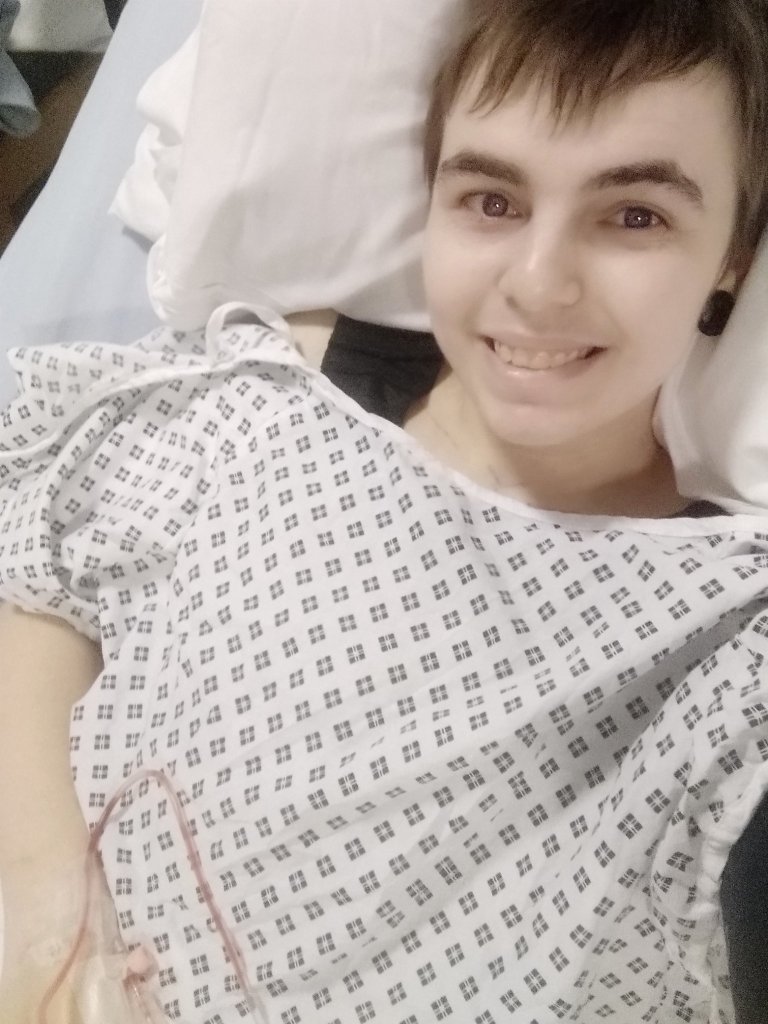
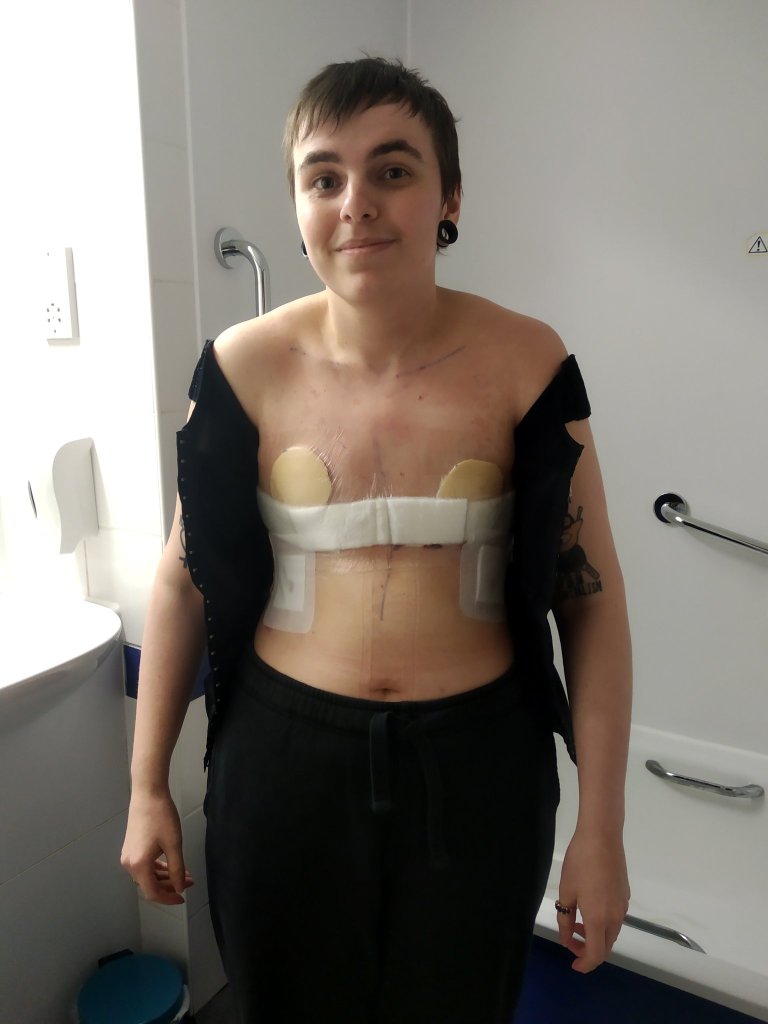
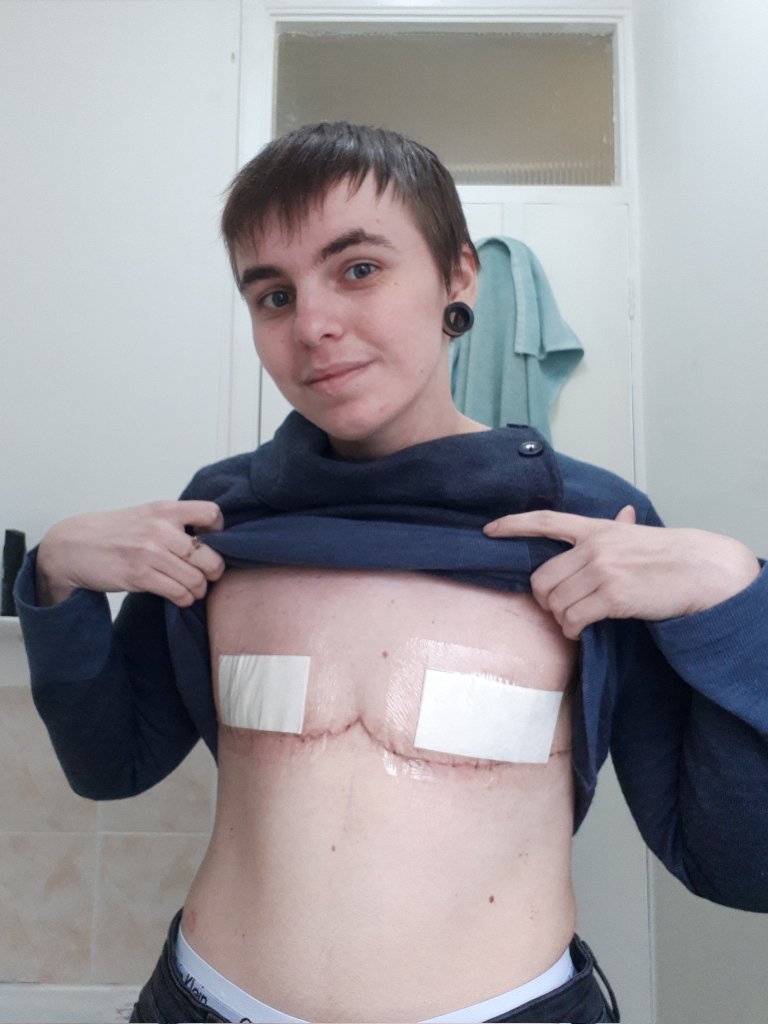
These images are of me on day 2, the day after I woke up from top surgery, pacing around my hotel room with the drains still in. Each person will have different energy levels and not everyone will be up and walking around right away, but it’s a great idea to start moving as soon as you can. I didn’t take any painkillers after surgery, so that helped me to be less sluggish – don’t be hard on yourself if it takes longer for you to get going, especially with painkillers making you fatigued.
Moving around doesn’t mean you should be doing sport or strenuous activity. When a surgeon says you should rest, they mean you shouldn’t do things that raise your heart rate a lot or that involve a lot of movement of the area where surgery occurred. Walking should be your best friend, in terms of physical activity post-op! Walking won’t pull on your stitches, provided you don’t try too hard to stand perfectly straight and don’t stretch, and as long as you take it slow you shouldn’t significantly raise your heart rate. You’ll heal faster and you’ll feel better. Plus, it might help you poop easier, and constipation can be hell after surgery!
For anyone who hasn’t had top surgery yet but wants to, I hope some of this info and myth-busting helped!
(If you’re interested in reading about the spectrum of experiences that transmasculine sex workers have, please check out my current project Working Guys: A Transmasculine Sex Worker Anthology!)
 Jack Talks About Sex Work