
A phrase you will see used by some sex worker advocacy organisations is the term “survival sex work”. Typically, this refers to people selling sex in precarious circumstances to meet their basic survival needs on a direct basis. Whilst people who are using prostitution as their sole income are obviously paying for their needs with those earnings, it is not generally considered to be survival sex work unless there is minimal delay in the usage of those funds. Imagine a homeless sex worker who sells sex and who trades sex for shelter for the night; that is survival sex work. A sex worker who is selling sex from home, who has a contract and secured housing and would have to be evicted to lose it, who uses some of the money they earn for food and some for leisure, is not engaging in survival sex work. Of course, there’s not exactly a clear line between these scenarios!
You could have housing but no money for food, and be selling sex and walking out of your door afterwards to buy food with that money. The selling of sex is happening for immediate survival needs, regardless of housing not being one of them. I tend to draw a distinction between whether I see something as survival sex work by what the driving force is for it – are you cold and selling sex for shelter, are you hungry and selling sex for food, are you sick and selling sex for medicine? Or are your most basic needs met but you’re selling sex so that they’ll continue to be met in the future, and so you can afford your wants beyond your basic needs.
A survival sex worker won’t always be selling sex on the street, though many do and those workers are often in the most dangerous situations. Some will sell sex in brothels, or find clients online and meet them at their homes or hotels.
As a population, survival sex workers are very difficult to count or find. Many don’t think of themselves as sex workers, or even as engaging in prostitution, especially if they’re trading sex for things other than money. Some who is paying for drugs with sex, or who is agreeing to trade sex for a place to say, is much less likely to think of themselves as a prostitute than someone who puts up ads on an escorting site and is paid money for sex. Avoiding viewing oneself as a sex worker or prostitute is encouraged by a society which places so much stigma on the work. Those who do understand themselves to be prostitutes and/or see themselves as sex workers are still likely to hide that, particularly if their workplace or manner of working is criminalized like with brothels or street-based sex work.
So, we don’t know how many survival sex workers are out there. We can estimate using various metrics, but they’re likely to give us very inaccurate numbers. Considering the intricacies of what would make something survival sex work rather than to be an example of a poor person who sells sex, and the fact we can’t even get good numbers for the total number of sex workers, we can usually only work out how many people need a resource targeted at survival sex workers by launching the service and seeing how many people use it. If the service is overburdened, it can take a long time to expand, and often the groups who grant funding want a clear idea of the size of the population in need before they’re willing to give it.
In the UK parliament, when discussing survival sex work in the context of a lack of access to Universal Credit and a high level of unemployment, officials used a definition of “survival sex” from the charity Changing Lives when discussing the issue in a Commons select committee.
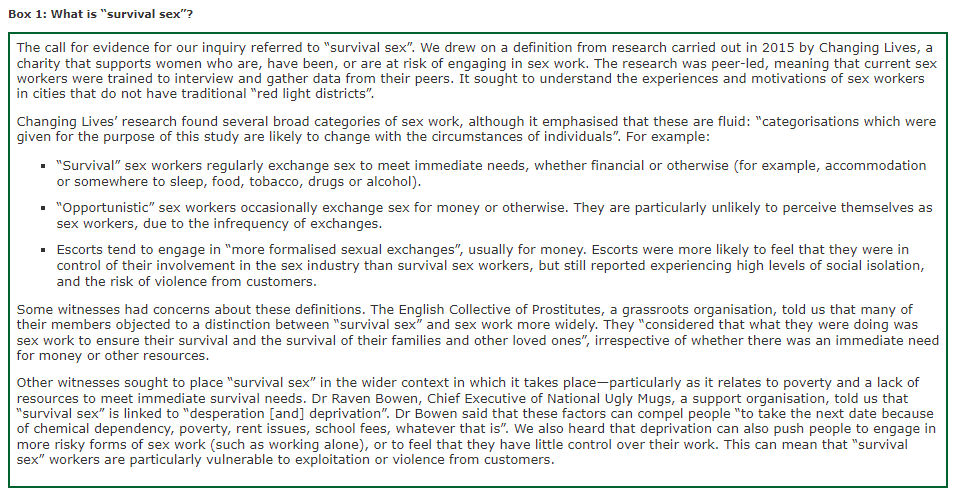
Of course, as is illustrated with the definition used, many sex workers object to drawing a distinction at all. Since almost all sex workers are selling sex specifically for the money, and most are working class people who use that money to pay rent and bills and buy food just like anyone else, some would argue that the distinction here is unreasonable when we don’t make it with other jobs. Although I agree that the distinction is often used unfairly to paint the average sex worker as privileged even when their work is immensely dangerous, I do find that it can sometimes be very useful.
If I want to distinguish between sex workers, maybe to describe who will be impacted by legislative changed by immediately becoming homeless and starving versus those who will be impacted in the same way in the longer-term, I think that’s worthwhile. Particularly if you’re trying to illustrate the scale of the issue, making it clear that survival sex workers are in the first most-impacted wave of people and that far more will soon follow is a way to put pressure on politicians who would otherwise think the fallout and harm had reached its peak. Hell, even if I just want to point out the subset of sex workers who were left behind or thrown under the bus before rollbacks of changes happen or support services step in, I should be able to name that subgroup!
I know that when I was trading sex for shelter, or when I was meeting a client while hungry and buying food for the first time in days with the money they gave me, that I wasn’t known to any organisation to be doing it. Any numbers that attempted to count sex workers at the time wouldn’t have included me. I was meeting my clients on Seeking.com (formerly Seeking Arrangement) and only my close friends knew what I was doing. These days I am very publicly known to be a sex worker, and I’m in the least precarious situation selling sex that I’ve ever been in. It doesn’t escape my notice that as I’ve needed support less, I’ve gotten more access to it.
All sex workers benefit from resources that make us safer. People who are in circumstances where they’re desperate for immediate income and can’t afford to turn down clients are the most in need, and yet we’re going to continue to be clueless about the size of the problem. This is why we need to tackle the causes, rather than the effect. The mantra “abolish poverty, not prostitution” comes to mind. When I was underage and selling sex for my basic needs, I wasn’t known the the government or any organisation as a sex worker… but my local housing office and several organisations knew I was a homeless teenager in need of money and food and shelter. As far as I’m concerned, anyone in poverty should be considered at risk of needing to engage in survival sex work. Any group aiming to support poor people should also be supporting sex workers and offering them resources.
Though I do sometimes see the term thrown around as a gotcha or a hypothetical, there are very real people in these situations right now. We often don’t get to speak about it until after the fact. I know that I had neither the means nor the desire to talk about the harm done to me when I was first selling sex. We need to hear from more people who’ve had these experiences, and particularly to empower those who are still engaging in survival sex to speak up and access resources.
 Jack Talks About Sex Work