
Being able to advertise the sale of sex online is absolutely vital for sex workers’ safety. It allows us to sell sex independently without relying on managers with access to networks of clients, and to avoid having to work in managed brothels or to sell sex on streets known for prostitution. Something that is commonly misunderstood, especially by people crying “End Demand!” and advocating for the Nordic Model which criminalizes clients, is that prostitutes are not selling sex simply because they see a market for it. Most prostitutes are selling sex because we desperately need money and selling sex is one of the best available options to get money that has no barrier to entry.
If you lower the number of clients, the number of people looking to sell sex doesn’t go down; the sex workers just get poorer and more desperate.
If you take away my ability to advertise myself and set a rate, where I can connect a phone number and vet clients by comparing their contact information to client blacklists, you take away those safety tools. Suddenly even the last-minute vetting procedures I do like looking out my window to see if a client is alone or is behaving strangely as they approach my door is taken from me, because I can’t work from a premises and advertise online to bring clients to me. I’m forced to rely on a manager who advertises through word-of-mouth or on hidden and shadier websites that fly under the radar.
I must express, a lack of ability to sell sex safely won’t stop those of us who are selling sex because we don’t have other options. For a fraction of sex workers, they’ll choose an option that was worse than selling sex with advertising sites but is better than selling sex from a brothel, like a job that makes them want to kill themselves or causes significant physical harm. For another fraction, they’ll be unable to find brothels to work in or won’t live near places where street prostitution is common, and so they and perhaps their children will go without food and suffer from worse poverty.
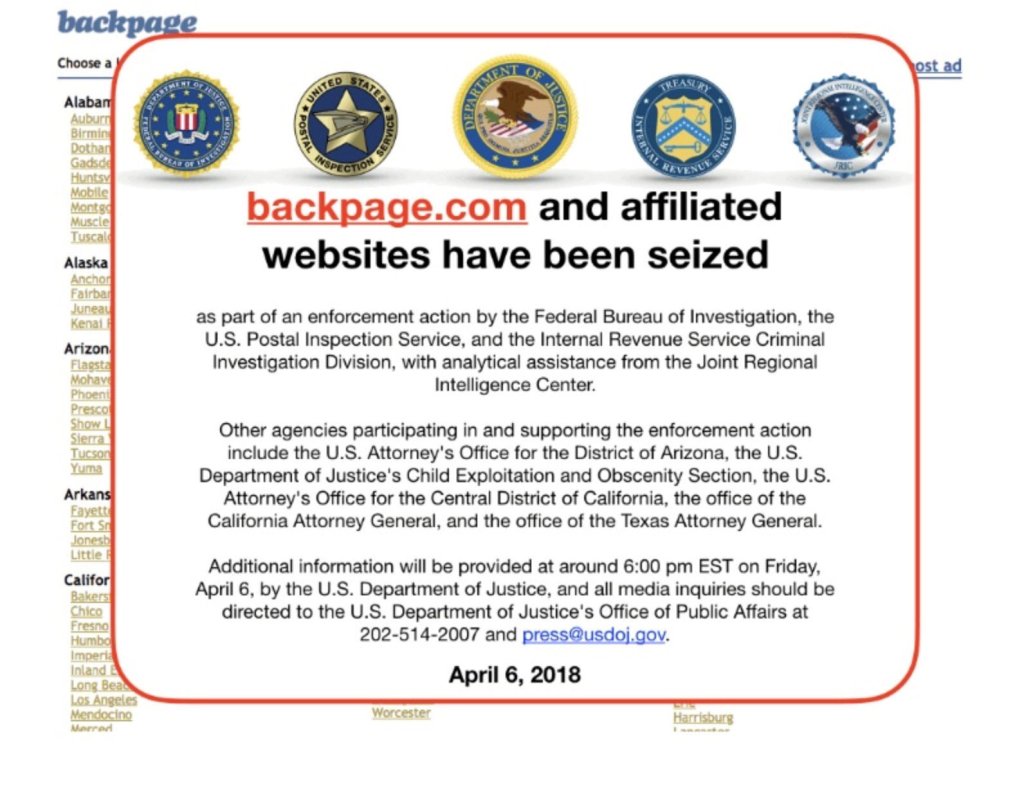
Have we not learned from the seizure of Backpage? Trick question: sex workers in general did not need to learn that the loss of Backpage would be immensely harmful, because we were warning people before it even happened. For the people who pushed legislation like SESTA/FOSTA, their concern was never for the safety of prostitutes. The closure of Backpage resulted in many sex workers returning to pimps or brothels where a large portion of their income was taken by 3rd parties and they had less control over their work.
The Online Safety Bill in the UK seeks to essentially ban all online advertising for sex workers, via a clause which adds “inciting or controlling prostitution for gain” to the list of priority offences that tech companies have to find and remove from their sites. Any advertisement of sexual services posted on a site could be argued to run afoul of this law. Given the severity of the penalty, most sites will be unwilling to take the risk and are likely to ban the advertising of prostitution entirely.
Those who have ever been self-employed and had to advertise their services online will be well aware of how hard it is to find clients without websites dedicated to it. Rather than being able to pivot to advertising in other settings, prostitutes are forced to break the law – street solicitation is illegal, advertising in phone boxes is illegal, and newspapers no longer permit ads for the sale of sex.
One piece of advice that I often give to other sex workers is to diversify income as much as possible, and to advertise on a wide variety of sites. Personally, I get most of my inquiries from only a couple of them, as a trans person who’s a much more niche taste than I used to be. Some websites will try to fight legal change as it happens and be careful to frame their sites as selling time and disallow any explicit references to sexual services, but many will crumble entirely. Will those that disappear be the only one or two that yield me decent client inquiries?
Sites that find it worth it to persevere, who ban explicit references to sex, make it much harder to communicate sexual boundaries. This increases the risk we face per booking.
If my advert states that I offer certain services and do not offer clients, many clients will not contact me at all if they want them. Those services might be specific sex acts, they might be roleplay scenarios, or requirements about protection. If I cannot state on my profile that I require condoms, that means I have to contend with clients who ask me for unprotected sex even more often than they currently do and I also have even less evidence that I laid out this boundary if I am stealthed (condom removed without my consent).
Issues with online advertising are rife, from the use of facial recognition technology to ban those of us who show our faces from travelling to certain countries to the possibility we will be recognized by someone we know and face the consequences of that. None of these have easy solutions, and plenty of people choose to work from brothels and never show their faces online for precisely this reason. However, having the option allows prostitutes to determine for ourselves what is the best course of action for us personally.
If you’re speaking to someone who is on the fence about this topic, who cannot decide whether they approve of online advertising of prostitution being permitted, ask them to consider whether they’d prefer for the advertising to be mostly contained or to be spread everywhere. I have no reason to advertise that I sell sex in phone boxes and on the street and to try and place coded advertisements into my local newspaper, because I have websites built for that purpose which will be far more effective. Whether you care about sex workers’ safety or not, even if it’s simply the case that you find us to be an eyesore or you’re worried about your kids coming across sexual content, it’s much easier to avoid seeing our ads when they’re in one place that you don’t seek out.
The only people who benefit from the banning of online advertising for prostitution are the powerful people and politicians who seek to exploit sex workers during their personal time and use us to stoke a moral panic around sex for their political agenda.
 Jack Talks About Sex Work