
To illustrate the problem with finding good data on sex work, I’m going to take you through a journey I had trying to answer a simple question: what percentage of UK sex workers are women?
First, to try and work out the number of women in sex work compared to men, I went to various sex worker led organisations to see what statistics they were putting out. The ECP offered this factsheet. I looked at the first claim, that there are 72,800 sex workers in the UK and 88% are women and looked into the source.

What I found from the source was that the total number of sex workers number… is an estimate based on a method so flawed that it’s laughable. Based on the average number of sex workers per specialized sex worker service, and the total number of services, they arrived at a total. What this is a good estimate of is the number of sex workers who are accessing a certain type of specialized service. It is not, however, anything close to a good estimate of the total number of sex workers. The assumption baked into this figure is that all sex workers are accessing services. Why would you assume that? Considering how stigmatized sex work is and the fact that those who are selling sex are notoriously hard to reach out to and provide help to, you’d think anyone trying to assess population size would factor that in! They did account for (or note the issue of) the fact not all service users might actually call themselves sex workers, but not for the fact that not all sex workers would be service users (whether they called themselves sex workers or not).
So, while I realized the population size estimate could be pretty much disregarded, I decided to still take a look at how they decided on the figure for the percentage of women in sex work.

Within the source, I found a table breaking down the percentages of each “category” of sex workers, first. They’re grouped terribly, as the ECP noted themselves when providing the source, with “male and transgender” as one category. According to this table, 65% of sex workers are “female” by their estimate and the remaining 35% are “male and transgender”. I couldn’t work out where the 88% are women figure had even come from! Some guess of what percentage of the “male and transgender” category was women, maybe? No, that doesn’t make sense. So, I dedicate myself to reading the entire thing.
It looks like the 88% figure comes from Day and Ward (2004) which keeps being mentioned alongside comments that men and trans people make up “5-12%” of the sex work industry. 100 – 12 does indeed equal 88, so I think I found where the number came from after trying to search the entire document for any mention of the number 88 and finding none! Woo! So, I go looking for this study. What I find is that it’s paywalled, and from searching around it appears to be a book. While I understand wanting to link something that isn’t paywalled for people as part of a factsheet, there’s no point in linking to a source that doesn’t actually contain the information and only mentions another. I requested access to the book to try and see where the data came from and kept researching while I waited to see if I’d get it.
The next thing I decided to do to find a reliable figure was to look into what figures the UK government claims and where they come from. I found this report from 2016, about prostitution. Within it, on page 9, I found this segment with citations:

I went to look at the citations for the numbers since here we have several different ones thrown around, to see if any of them were more accurate than what I found so far.

Clicking the links on 10 and 11 sends you here, to a page that was supporting evidence given that mentions various studies but is decidedly not the citation promised for number 11. This supportive evidence is a worthwhile read and makes some good arguments about how we should be considering all of the demographics that sell sex and not only discussing it as violence against women and girls, but it doesn’t have statistics on the percentage of women selling sex. Also, the link promised for number 11 was supposed to be to the Sex Work Research Hub which “cited research” in the first place, not a direct link to the research itself! Why not send me directly to the information I want?
Next, I have to track down the Sex Work Research Hub statistic, since the report doesn’t link to it. I can’t find any sign on their website of the “80%” statistic for the number of women in sex work. When going through their “briefings” segment, I find a list of sources at the bottom of the page. Theoretically, one of them could contain the 80% figure but from reading through their descriptions none appear to be studies on the gender demographics in sex work.
I decided to look into the 95% figure given. That link works, but instead of getting information on how they came to this estimate I get:

It turns out this 95% figure is just a guess! Not based on a study at all, and comes from the ECP who no longer estimate this and instead say it’s 88% based on numbers from a source they site which actually estimates only 65% but references another study which estimates 5-12% of sex workers are “male or transgender” but that is paywalled and likely comes to those figures based on flawed methodology like everything I’ve found so far! Complete dead end! While I still don’t know how Day and Ward (2004), from the source the ECP uses, got their stats, I figure it’s worth looking into more sources in this flawed government report. I decide to use the segment just before “gender” which talks about the total number, because while the estimate of 72,800 total sex workers is nonsense, they also have a 58,000 figure for the number of women in sex work. If these flawed estimates are flawed in the same way as a total, that doesn’t necessarily mean they’d be useless in terms of comparing them to get a percentage for the number of sex workers who were women. If 58,000 of 72,800 are women, that’s around 80% women! Close to one of the figures we looked at earlier! I’d still have the issue of it only representing the demographics for sex workers who access services, but it’s somewhere to start.
I click through to The Fawcett Society‘s written evidence who “referenced research” (why won’t they just link to the research itself?), then from there to the research discussed.
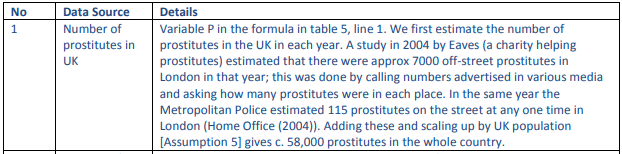
The research ultimately isn’t claiming 58,000 women in prostitution, it claims 58,000 prostitutes total and isn’t gender-specific. The number is based on London only and they extrapolate from there, and their method of calling numbers from various sites and asking “how many prostitutes were in each place” is ridiculous. Most brothels and agencies won’t give out that info (because they’re operating illegally) and individual sex workers who work in those places will lie to protect themselves and their income, plus this completely ignores independent sex workers and their listing and assumes us all working in groups. That, plus the estimate from the Met Police to account for street sex workers as if that information can be used to assume amounts for the rest of the UK makes this data useless to me.
I went in wondering the percentage of the sex worker population that was women, now I’m deep into realizing that almost all of the data we have about sex workers is either complete guesses or the method used to estimate leaves us with nonsense figures.
I’ll include the link again here for anyone who wants to go through it, but essentially, the research that was cited for the 58,000 figure was from ” Changes to National Accounts: Inclusion of Illegal Drugs and Prostitution in the UK National Accounts” and was meant to calculate the earnings total of the sex worker population in the UK. It is full of so much crap that it hurts to read – from calculations based on assuming 25 clients a week (a number picked based on sex workers in Amsterdam even though what they cite actually assumed 3 clients per day and not 25 per week and also assumed 3 clients per day based on… we don’t know what, because they don’t say) to the assumption that “Punternet” would be an accurate resource for the average escorting rate.
I’ll spare you the step-by-step for how I found all the other sources I looked through. Lots of people cited Kinnell (1999) for various claims, which turned out to be unpublished and used in a briefing for England and Wales. I managed to find this from 2009, where Kinnell herself (among others) criticised the media’s use of the figures within and exposes how flawed the figures were. One of those figures was an estimate that the UK population of sex workers was around 80,000. They also discuss the various issues with assumptions about all sex workers being women and a lack of consideration for the real demographics. Nothing within that gets me closer to accurate information, though, just shows the flaws in the stats being quoted.
Another that I saw lots of reference to was Scambler (2007), which I requested the full link to beyond the paywall, but all of the relevant numbers came from Kinnell (1999) and Day and Ward (2004). That was true for lots of other things I found. Like this by the “UCL Institute of Health Equity” for “Inclusion Health, Department of Health”. Or this, by the University of Bristol.
I couldn’t find a single study that meaningfully calculated the total number of sex workers in the UK or that estimated a percentage of sex workers who were women in a way that wasn’t so deeply flawed as to be useless.
Any population which is highly stigmatized and criminalized will be hard to study. Sex workers won’t generally want to be studied and will avoid being counted because being known to be a sex worker puts them at risk of various legal and social issues. Even for sex workers who aren’t actively avoiding being counted, a lot of sex workers never access services targeted at sex workers and so are never counted there.
What is deeply frustrating is that I hear numbers thrown around regarding sex work that turn out to be nothing more than guesses or which are estimated in ways that don’t make sense and clearly won’t be accurate. I see these numbers everywhere and treated as fact, used by the government in their reports and by politicians in their speeches, and they’re bullshit.
I don’t expect the UK government to actually support sex workers. No matter how hard we push for decriminalization or show that the existing laws do harm to sex workers, they don’t listen. I’m not particularly hopeful that if we just got certain data then they’d be more willing to listen and help sex workers, but it definitely couldn’t hurt!
We can’t know how many resources need to be allocated to sex workers or the scale of these issues unless we have numbers. In the absence of them, we should be able to admit that we don’t know how many sex workers there are and should keep increasing the resources offered until no one’s taking them anymore.
 Jack Talks About Sex Work
Very interesting research. Congratulations on your insight and persistence. The official numbers are so much lower than the new COVID reality. Which sadly has negative impacts on available funding and support.
LikeLike