In most of the discussions on trans people in prison, transphobes are focused on trans women. “Gender Criticals”, a group that argues against trans people’s rights to be recognized as our genders, demonize trans women and suggest they are a threat to cis women. When these “Gender Criticals” talk about prisons (like among the hashtag #KeepPrisonsSingleSex on Twitter), their main focus is on trans women and demonizing them. Trans women are not a danger to cis women, they are far more likely to be victims than perpetrators of violence, and like any other women, they should be able to stay in women’s prisons when incarcerated.
I’ll note, I think no-one should be incarcerated at all. In the context of this discussion where prisons do still exist, we cannot allow vulnerable populations to be made even more vulnerable inside them.
As a trans guy, I’d like to talk about trans men who are incarcerated. As someone who sells sex and sometimes does so in ways that put me at risk of arrest, this is something I think about often. Recently, when the hashtag #KeepPrisonsSingleSex started trending, I posted.
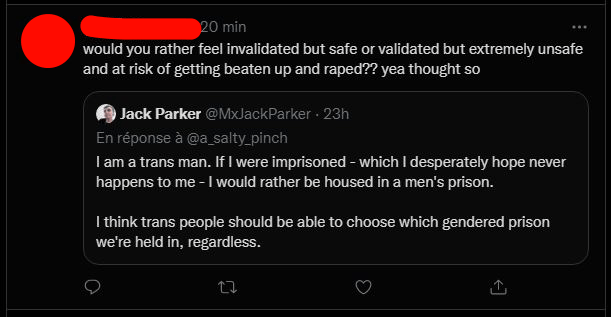
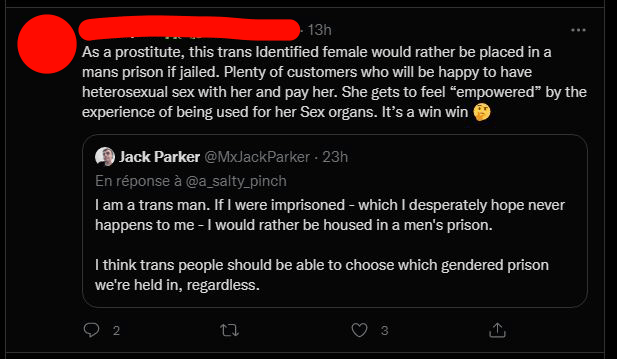
This tweet alone got me a significant amount of harassment, as did the following couple more in the thread. The one which got me the most extreme amount of harassment and that has me wanting to talk about trans men and prison is this:
At the time of writing, just over 24 hours after I posted this tweet, it has 268 quote tweets. Many of these are from large accounts with tens of thousands of followers. I had muted the thread and blocked replies before I went to sleep, but whilst I slept the harassment built up.



Now, most people have heard that there is a high rate of sexual assault within men’s prisons. In the UK, the MoJ’s data on this is woefully lacking. We only have information on how many cases are reported and then recorded. Just like outside of prison, most victims do not report their assaults.
When comparing what the Ministry of Justice says the number of sexual assaults is in men’s prison to women’s, we see a disparity. 364 assaults reported in 2019 in men’s prisons vs. 25 in women’s prisons, 239 vs 17 in 2020, etcetera. In 2019, there were 79,140 men in prison and 3,795 women. If we were to believe these figures as accurate, not only would this make women more likely to be sexually assaulted in prison than men, but it would also suggest the risk of being sexually assaulted in prison is much lower than being sexually assaulted outside of it.
All of this being said: we don’t have good data. It is obvious to me that out of a population of almost 80,000 men in prison, far more than 300-or-so are being sexually assaulted in any given year. There has been research which asks a sample of former or current inmates about their experiences, and that gives us figures that are higher. What we can extrapolate from the information we have, in my opinion, is that being in prison puts people at much higher risk for various kinds of violence.
Trans people are a uniquely vulnerable group. Naturally, the data on trans people’s experiences in prison is even more scarce than the data on experiences of assault in general.
For trans men in discussions about “single-sex” prisons, which is intended to mean prisons which are segregated on the basis of a person’s sex assigned at birth and not their sex as currently recognised by their doctor or even their re-issued birth certificate if they have a GRC, it is assumed that trans men will always be safer in a women’s prison. Men’s prisons are dangerous and have higher rates of violence, and it’s noteworthy that a higher proportion of men are imprisoned for violent crime. One would assume that both trans men and trans women would be safer in women’s prisons, based on that, because one might assume that anyone would be (especially the uniquely vulnerable).
My position is that as long as prisons exist and are generally gender-segregated, trans people should get to decide which prison we are placed in. The reason for this is that trans people are uniquely at risk and we are at risk in different ways depending on which kind of prison we are placed in. This should be a decision that trans people are allowed to weigh up for themselves – particularly because attacks and targeting from other inmates is not intended to be a part of someone’s “punishment” during their sentence.
Prisoners aren’t generally given a choice on various matters because the prison system strips people of many of their rights in a way that is egregious. It’s not that I’m naive to this. Discussing how things could be changed does not suggest a lack of awareness of how things are. I think it is unlikely that trans prisoners would be permitted to choose what facility they are placed in, or even that anyone involved in the legal system would reasonably assess their safety in each kind of prison, but that isn’t a reason not to advocate for it.
The thing is, in the case of trans men, it’s not so simple as saying that men’s prisons are more dangerous and therefore trans men should be placed in women’s prisons for their safety. Many “Gender Critical” people will argue that cis men are a threat to each other (and it cannot be determined which ones are not a threat) and therefore should be housed together. Since they assume that trans men are never a threat to cis men or to cis women, the argument is that they should be housed with women. The issue with this line of thinking is that no consideration is being made about who and what trans men are at risk from.
Trans men in prisons are absolutely at risk from male inmates, just as cis men are in men’s prisons but to an even greater extent because of their transness. However, one of the main forms of harassment that goes overlooked in prisons is by guards. When guards strip search inmates, that isn’t considered to be sexual assault. It’s just as traumatizing when a guard strip searches you and touches you and looks at your genitals as if someone who isn’t a guard does it to you, however, it’s sanctioned by the state and therefore not considered to be harmful.
For information about trans men’s experiences, we often have to rely on individual accounts, like those of trans men like Graham who said that rather than offering him greater safety and security, the women’s prison “was a million times worse”, among other accounts from trans men who detail their suffering in women’s prisons. (Link)
Men’s prisons are dangerous, though many people talk about the rape that occurs within them in a manner that comes across as fantasising. I often see this from people who essentialize male violence and who see the harm that occurs in men’s prisons to men as being deserved. I’ve had these kinds of fantasies levelled at me personally, with people discussing how they imagine I’d be raped in a men’s prison.
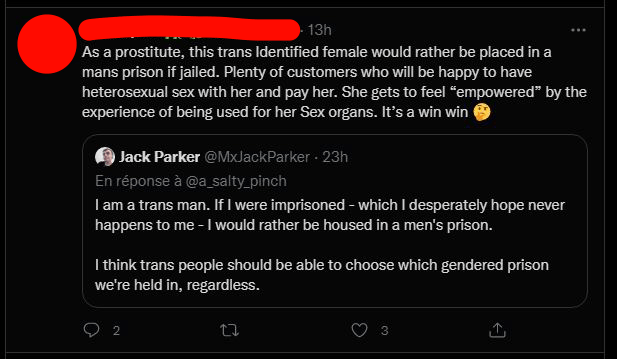
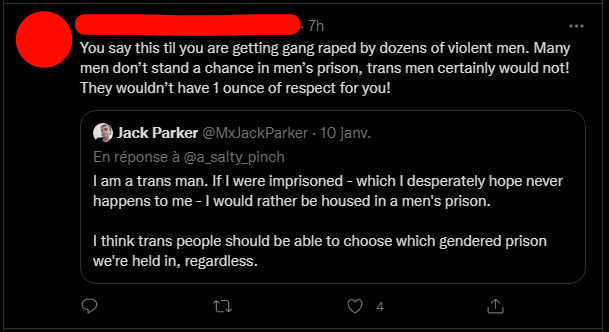
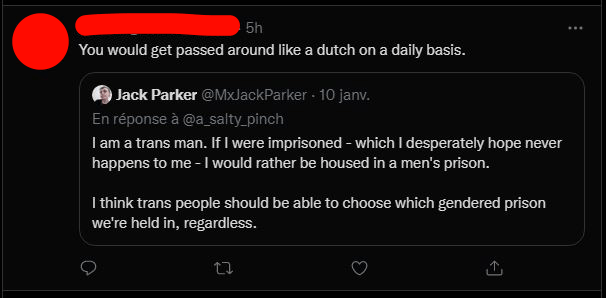
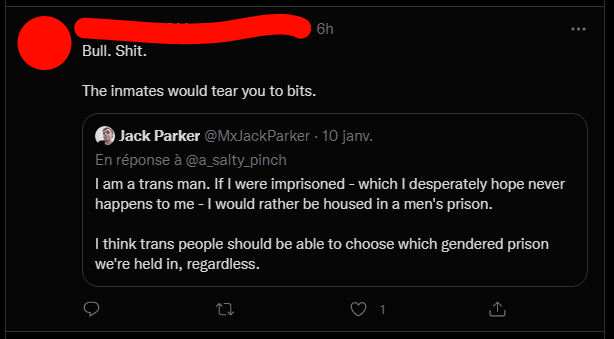

The images above are just a small sample of the posts directed at me, talking about the idea of me being raped with what seems like glee and descriptions like “turned inside out” and “tear you to bits” and “gang-raped by dozens of violent men”. These are fantasies of harm being done to me that generally speaking don’t match the reality.
The reality inside of men’s prisons is of course more complex. Many people who talk about the rape rate in men’s prisons essentialize male violence as being something inherent to men as a group and they see rape within prisons as an extension of their punishment. Instead of pushing to reduce rape in men’s prisons, which is absolutely possible because there are plenty of countries where the rate of sexual assault in men’s prisons isn’t as high as in the UK or US. Rape is not an inevitability for men in prison and the rate varies significantly depending on the unit and how violent the offenders are.
Within prisons, much of the sexual assault takes to the form of “coerced sex”. The types of coercion involved are often related to finances or drugs or protection from other kinds of assault. This kind of transactional sex is something I am intimately familiar with, as someone who has engaged in survivals sex work. Instead of understanding that this leaves me equipped to weigh up the risk better than average, it is assumed that I must want to have this kind of transactional coerced sex.
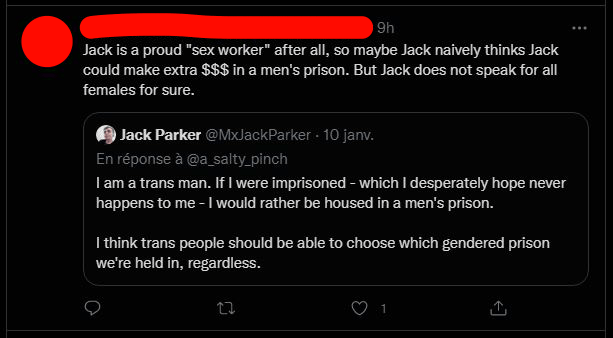

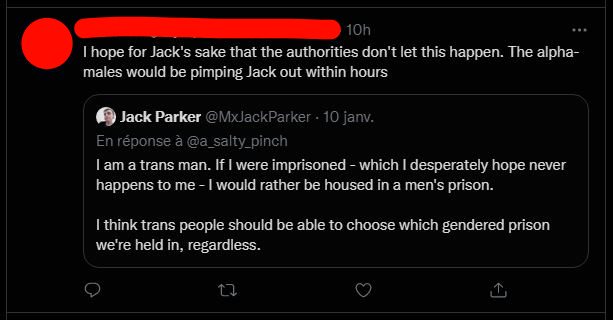
Personally, the risks of being denied HRT and forced to present femininely alongside the fact that I would still be at significant risk of sexual assault and harassment from guards and the high likelihood of being placed in solitary if even one female inmate complained… all means that when I consider where I would rather be placed in the terrifying event that I was incarcerated, a men’s prison would possibly be “safer” when I consider the long-term impact on me (assuming a case where I was incarcerated after having gotten top surgery, which I’m getting next month).
Not all men’s prisons are equally dangerous, since inmates are separated and given different security depending on the type of crime. If I were imprisoned for a violent crime, I would likely weigh up the risks differently and may ultimately decide that while all options are bad that a women’s prison would be preferable. In the case of non-violent crime, which is what I am imagining when discussing what I’d be most likely to be imprisoned for, the risk of being denied HRT and forced into solitary in a women’s unit starts to surpass the risk in the men’s unit again. There is not a one-size-fits-all solution.
Given the current guidance on what should happen to trans inmates, and the fact that there are currently no trans men recorded as being placed in men’s prisons (but some who are in women’s prisons), if I were ever arrested I would almost certainly be placed with women.
The risks to me as a trans man, whilst substantial no matter what prison I’m placed in, pale in comparison to the specific targeting of trans women in prison. As long as gender-segregated prisons function the way they do, assessments of which prison a trans person goes to should be about where they’re safest and should allow the trans person to decide that.
If one were to argue that women’s prisons are safer for trans men, that wouldn’t mean that trans women should be placed into men’s prisons. People aren’t placed into prisons depending on which is the safest for them in the first place or based on who they’re a threat to. People are imprisoned based on what is easiest for the state and what the public will accept and want to see for their prisoners. The general public has known about the problem of rape in men’s prisons for a long time and is more than willing to tolerate it, but the idea of mixed-gender prisons is intolerable to them and that’s why prisons are separated the way that they are. It’s not for any sort of feminist reason to protect women, who still harm each other within prisons and are still subject to harassment from guards, much of which the government explicitly allows and doesn’t even consider harassment.
I don’t want to have to argue about this. “Gender Critical” people aren’t arguing in good faith, they only want to use prisons (like bathrooms or changing rooms or sports) as a wedge issue and an excuse to demonize trans women and erase trans men. The conversation exists as an excuse to misgender us and treat us as criminals.
I don’t want to talk about which prison trans people should be placed in. I want to talk about how we resolve poverty and end the persecution of trans people so that we aren’t pushed into crime and then the prison-industrial complex in the first place.
I don’t want anyone in prison, including trans people. While prisons exist, I don’t want us to treat the rape that occurs within them as if it’s a fucking inevitability; I want to eradicate it.
 Jack Talks About Sex Work