
To argue against the decriminalization of sex work and to infantilize escorts to the point of arguing that arresting us is what’s best for us, people will talk about how dangerous it is to engage in prostitution. It is common for those who argue for the Nordic Model for sex work, or who want to keep it criminalized, to discuss the trauma that many sex workers experience in graphic detail as an emotional argument. I have seen people invoke the idea that young girls don’t grow up wanting to be sex workers, to get people to have an extreme negative reaction because of the association between children and sex work.
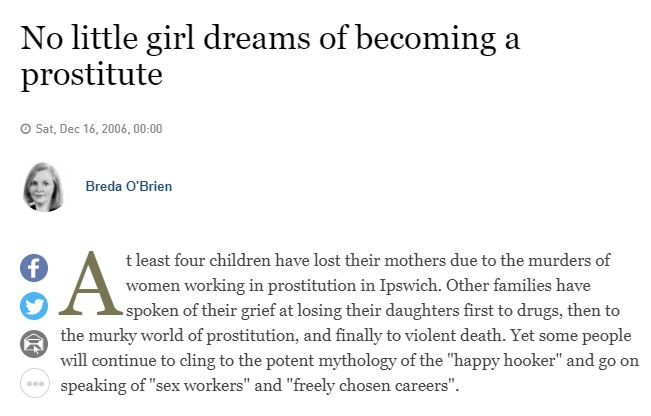
People will make these comments, about how often sex workers are abused, perhaps throwing out various statistics to talk about how common it is. I have been personally targeted by people making these comments every time I talk about my career, especially when I was using certain social media platforms to advertise. I see these arguments employed by the media, hoping to tug on the heartstrings of people who don’t know better. They frame these things as being proof that prostitution is inherently wrong, and encourage people towards an inclination to fix the problems they propose with criminalization.
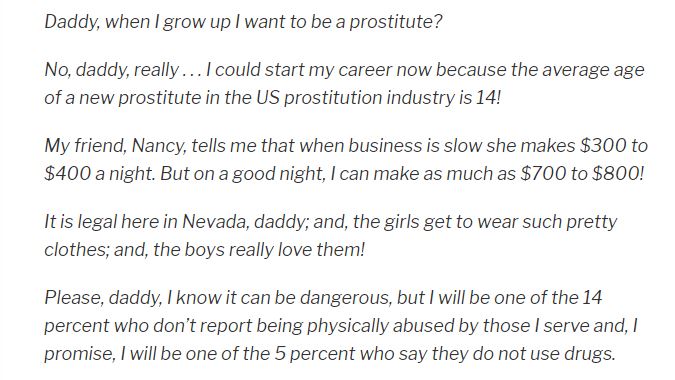
In response to these arguments, some sex workers respond in a way that many groups do, which is that they try to counter these points by creating a “respectable” sex worker narrative. Hence the idea of the happy hooker. When so many people are convinced that prostitution should be illegal because it is inherently harmful, all they have to do to disprove that is use themselves as an example of someone who is not harmed by it. That way, they serve as proof that it can not only be done safely but even enjoyed! If people are convinced of that, the idea is that this will lessen stigma over time and create two distinct groups: happy consensual sex workers, and victims of trafficking.
A lot of people who play into this narrative are sex workers who are able to work legally, in the countries or states where it is permitted under some circumstances. The persona not only serves to combat certain types of stigma, but also serves as a tool for advertising. People who might otherwise be hesitant about seeing an escort may be convinced by a sex worker who claims to love their job and who talks openly about the industry. It can be charming to clients, for them to feel like they’re getting a peek behind the curtain, and comforting for them to be reassured that the sex worker they’re going to see isn’t being coerced by a third party or financial needs.
I often play into this myself, with certain clients. Clients who are nervous, or who ask me lots of questions like “Why would a nice [person] like you be doing this?” or “You’re so sweet, what got you into the industry?” during appointments. In my experience, they usually want to me assuage their guilt. Since I want their money, and am often trying to ensure I get repeat clients, I lie. I claim that I love my job and I lie about having better home or brothel security than I do (depending on where I’m working at the time). Usually I play the part of a student who does sex work part-time, rarely sees clients and has fun doing to. On a few occasions, I have pretended that I fell into sex work because I was so promiscuous that it was interfering with my university course and that it was easier to turn it into a part-time job. It’s so ridiculous to me that I could both laugh and cry, repeating that.
There are some people who genuinely enjoy selling sex – I am not saying they don’t exist. The fact is, they are rare. There are far more sex workers who feel mostly neutral about it or vaguely negative, like many people do about there jobs. A large portion of sex workers actively dislike the job, and do it because they lack options to meet their financial needs. I have ranged from hating it and sometimes crying after appointments, to mostly enjoying the job and finding moments during sex to be frustrating or annoying but ultimately fine. Being an escort has never been something that made me actively happy. The money has often made me extremely happy! I’ve just never enjoyed the work itself, aside from the occasional client here or there.
The “happy hooker” narrative is not ideal to combat the arguments being made by those who seek to criminalize us, because it misses to point. Yes, sex work is dangerous. It is made more dangerous by criminalization, and regulations cause more harm to sex workers than full decriminalization does. That is the argument that I want people to hear, because I think it’s the one that makes the most sense.
I am not a happy hooker. I’m bitter as fuck. I’ve been assaulted many times whilst involved in sex work, and I have a history of abuse before it. My experience with prostitution is messy and I started when I was 17 and homeless and desperate. If prostitution had been illegal here, I still would have done it, but I would have been in far more danger. The things that actually would have helped me were better programs for homeless people, a better benefits system in the UK that processes people faster and pays them more, and for social services to have gotten involved in my abusive household before I got kicked out at 17.
Sex workers deserve rights not because we all love our jobs; we need rights because of all of the abuse that happens. We need to abolish poverty, not prostitution. In the meantime, I am safer when clients can’t use threats of reporting me to the police to get me to do things. I’m safer when I’m not risking being assaulted by a police officer again, who can use threats regarding legal consequences to coerce me. I’m safer when it’s not illegal for clients to buy sex, because then I’m not dealing with a reduced pool of clients only made of people who are already willing to break the law!
Brothels are illegal in the UK, even though selling sex from your own home is not. A brothel is anywhere with more than one sex worker who works from the same premises. The first brothel I ever worked in, I lied to many clients who asked me about the place and told them I was staying there whilst on break from university, since I couldn’t stay in my university dorm and had no home to return to. To those who I was suspicious of, when I felt a risk that they would be violent, I told them that there was CCTV and that I had my “manager” in the living room in case anything happened, as casually as I could. The illegal nature of it meant that I couldn’t have worked with other sex workers and hired us security. Our security consisted of a “manager” that I didn’t know or trust who took half of my income. If brothels hadn’t been illegal, I would have rented a place with other sex workers I knew and we could have arranged our own security. Police raids of brothels are so common in London that we couldn’t risk that, so I relied on criminal men who were willing to take on that risk. It’s the running, or helping in management of a brothel that’s illegal, not the running of one.

If you regulate sex work, you create a group of sex workers who are able to do it legally, and then all the people who turn to sex work whilst homeless or out of desperation are still criminalized because of their inability to comply.
When you fully decriminalize sex work, you give sex workers control over our own work. Even systems where it is legal and regulated cause us to have to register or gain licenses when the police are often the people hurting us most, or we are put in situations where we are exploited by those with the resources to run brothels or obtain licenses.
Please, when you hear people talking about how they are happy to be sex workers and love their job, remember that doesn’t need to be true for us to deserve rights. Plenty of abuse happens to sex workers. We deserve rights because that’s the best way to combat that abuse. To stop people who don’t want to do sex work from getting involved in it, you need to tackle poverty as a factor that pushes many of us into it. I wouldn’t have started if I hadn’t been homeless.
For every sex worker who is in a relative position of privilege within the sex work community, remember that there are a great deal more of us who have things to say too.
 Jack Talks About Sex Work
One thought on “The “Happy Hooker” Narrative”